

In 2026, the question for CMOs isn’t whether to use AI—it’s how to make it reliable, measurable, and differentiating. Adoption has surged: McKinsey’s 2025 survey found 79% of organizations now use generative AI. Yet maturity lags—only 31% of AI use cases reach full production. This gap is where budgets and org design must focus.
Last year, we identified 25 AI marketing statistics. This year we’ve refined them to 19—each chosen to support a specific CMO decision: budget allocation, hiring priorities, or governance frameworks. In 2025, we worked with clients who achieved measurable conversion lifts and time-saved outcomes by standardizing agent workflows with validation and human review.
What you’ll gain in five minutes: clarity on where peers invest and which KPIs prove marketing automation ROI in 12 months.
We’ll cover Adoption & Investment, ROI & Performance, Operational Efficiency & Content, Competitive Advantage & Customer Impact, and Implementation Reality & Risk.
Adoption and Investment Benchmarks for 2026
Near-Universal AI Adoption Across Marketing Operations
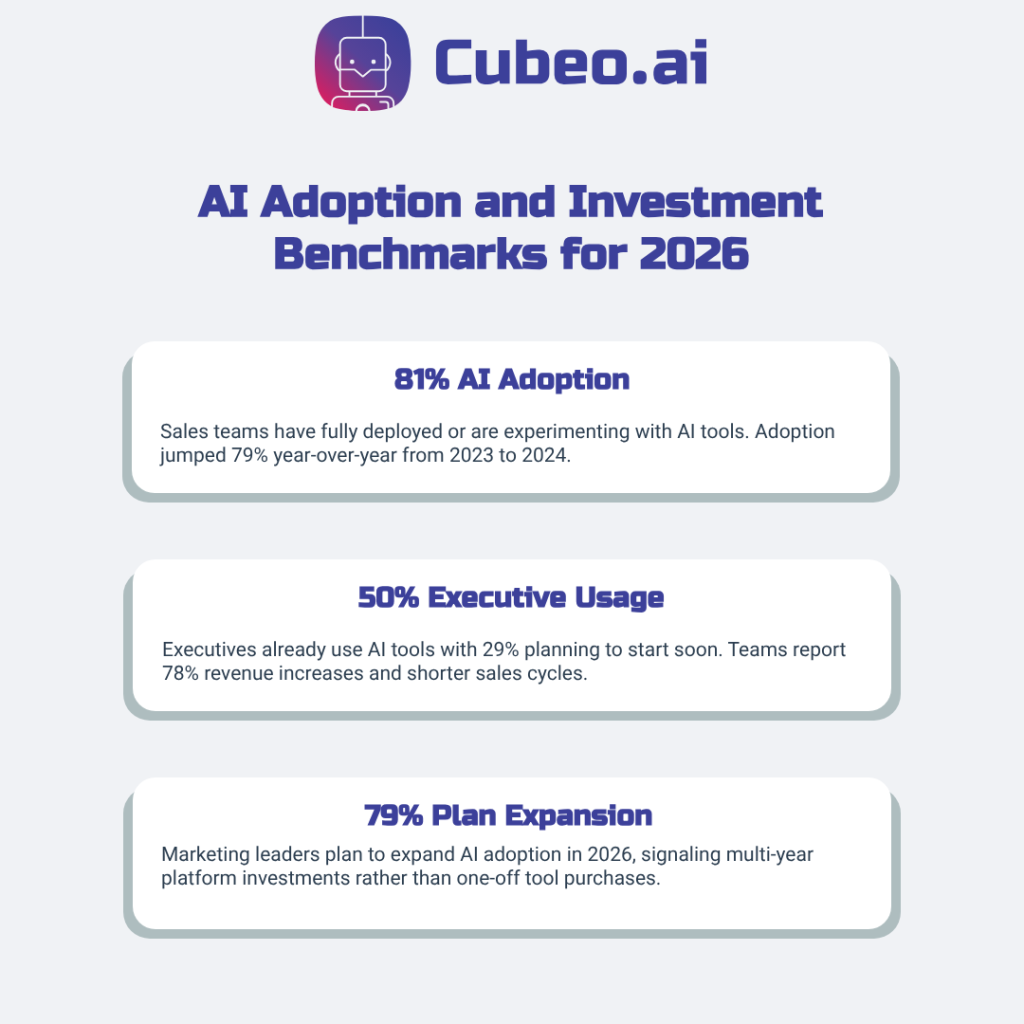
81% of sales teams have fully deployed or are actively experimenting with AI tools. Adoption jumped from 24% in 2023 to 43% by late 2024—a 79% year-over-year increase. Compared with last year’s baseline, AI moved from early adoption to operational standard. Over half of sales professionals use AI daily, doubling their likelihood of exceeding targets.
What this means: Run a 90-day optimization audit measuring cycle time to campaign launch and CTR lift as primary KPIs. Stop debating adoption; start measuring execution quality.
Marketing and Sales Lead AI Spending Increases
Marketing and sales are investing ahead of other functions. 50% of executives already use AI tools, with 29% planning to start soon. Budget follows outcomes: teams deploying AI report 78% revenue increases and sales cycles shortened by one week on average. Early deployments boosted win rates by over 30%.
What this means: Justify increased AI budgets by tracking three CFO-friendly metrics— cycle time reduction (days), win rate improvement (%), and revenue per rep. Tie every dollar to measurable outcomes.
Multi-Year Investment Commitments Signal Confidence
79% of marketing leaders plan to expand AI adoption, signaling platform investment rather than one-off tools.
What this means: Budget three infrastructure items now—platform licenses, governance and monitoring tools, and a 6–12 month change program. Track payback through error-rate reduction and time saved per campaign.
Quantifying AI Marketing ROI
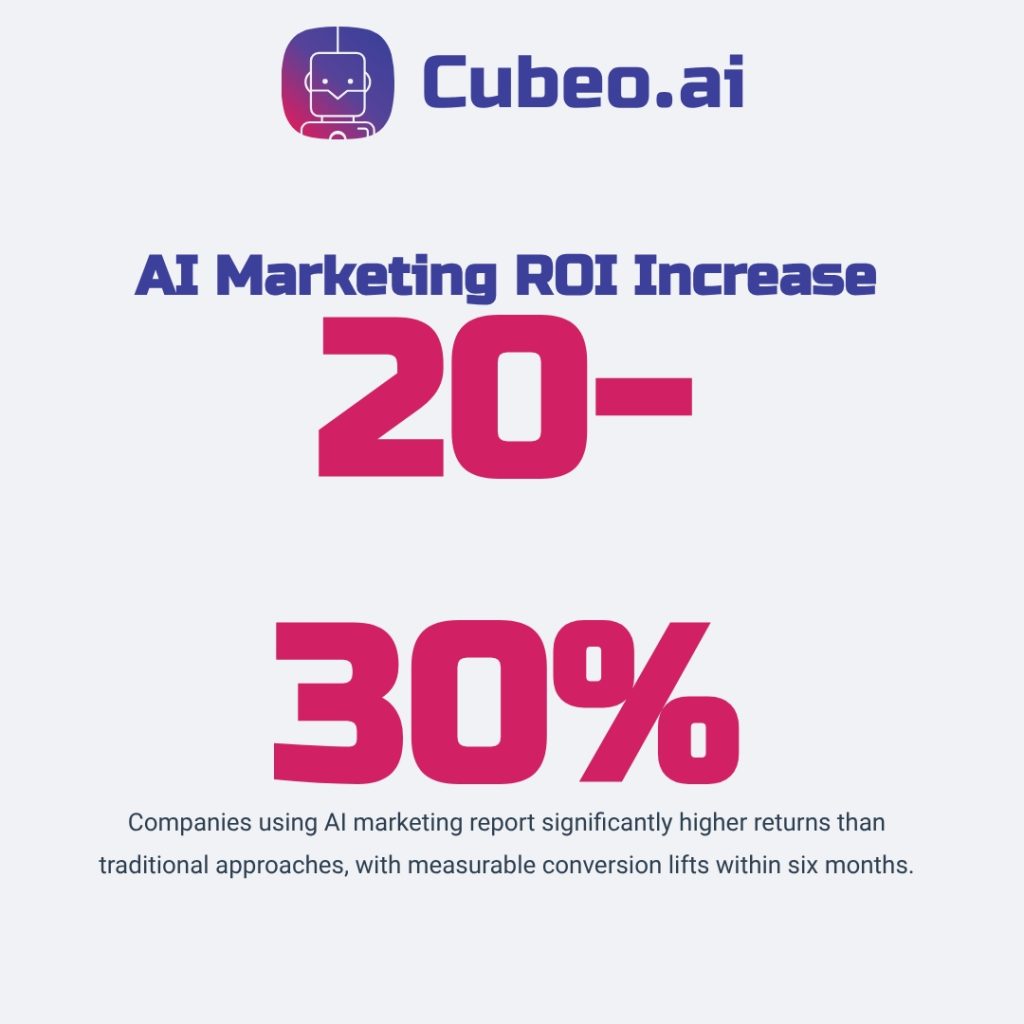
AI Marketing Delivers 20-30% Higher ROI
Companies using AI marketing report significantly better returns than traditional approaches.
What this means: Budget for 12–18 month payback and make cost-per-acquisition your primary ROI metric. AI investment pays for itself through improved campaign performance.
Campaign Speed and Performance Both Improve
Dual gains: faster cycles and better outcomes — AI doesn’t trade speed for quality. Marketing automation workflows reduce campaign setup from weeks to days while improving CTRs through continuous optimization. Teams running 3x more experiments see compounding performance gains quarter over quarter.
What this means: Allocate 20% of saved time to additional testing cycles. Track experiments launched per quarter as a leading indicator, alongside final CTR.
Sales Impact Extends Marketing AI Value
Sales productivity: one-week shorter cycles and measurable revenue lift — Wharton’s 2025 report documents positive returns across sales and marketing functions. JPMorgan automated legal reviews, saving 360,000 staff hours annually—roughly 173 full-time employees or $10–15M in annual payroll capacity.
What this means: Frame marketing AI as revenue enablement. Show CFOs the FTE equivalent savings and expected lift to sales close rates when requesting budget.
First-Year ROI Reduces Investment Risk
72% of enterprises measure AI ROI; 75% report positive returns — Wharton’s 2025 adoption report confirms payback typically occurs within two years, often faster for marketing use cases with clear conversion metrics and standardized workflows.
What this means: Use standard annual planning cycles to evaluate AI projects. Require 12- month ROI projections tied to cycle time, CTR, and cost-per-lead before approving investment.
Operational Efficiency Gains Reshape Team Capacity
Daily Time Savings Translate to Capacity Gains
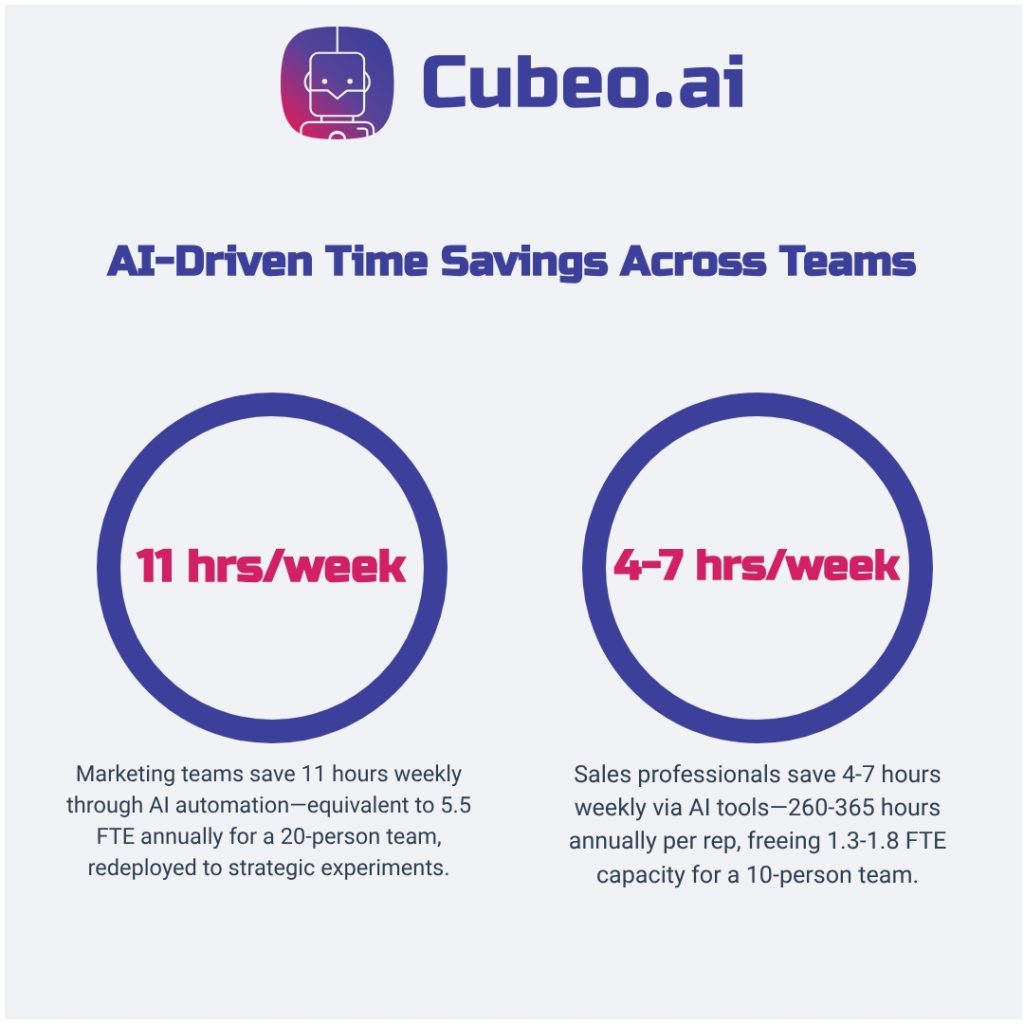
2 hours saved daily per sales professional — Bain reports sales teams save 4–7 hours weekly through AI automation. That equals roughly 260–365 hours annually, or 0.13–0.18 full-time equivalents (FTE) per rep. For a 10-person team, expect around 1.3–1.8 FTE freed —roughly $140–270K in redeployable payroll capacity (illustrative, based on $110–150K average loaded cost per rep).
What this means: Show your CFO the FTE math and propose reallocating that capacity to direct revenue activities—customer strategy, relationship building, market analysis.
Content Creation Automation Reaches Majority Adoption
63% of marketers use AI weekly — Content creation leads adoption across marketing functions. Leverage AI Agents to automate drafts, media production, and approval workflows so quality stays high while output scales. With AI handling production, your constraint shifts from volume to message differentiation and positioning.
What this means: Use saved capacity to run controlled positioning tests. Track lift in CTR and conversion as primary success metrics, not just content volume produced.
Weekly Automation Savings Accumulate Significantly
11 hours saved weekly per marketer — Across a 20-person marketing team, that’s 220 hours weekly or roughly 5.5 FTE annually.
What this means: Track saved hours monthly and explicitly reallocate 50% to experimentation and new channel testing. Measure success by experiments launched per month, not just time saved.
Administrative Automation Becomes Table Stakes
Widely automated administrative tasks — Scheduling, reporting, data entry, and CRM updates are now broadly automated across marketing teams. Administrative efficiency is baseline. Competitive advantage comes from automating strategic workflows—lead scoring, campaign optimization, creative testing—where speed and judgment compound returns.
What this means: Audit your team’s admin automation coverage. If below 80%, close that gap first. Differentiate by automating strategic work, not just efficiency tasks.
Competitive Advantage Depends on AI Execution Quality
AI Reveals Previously Invisible Insights
AI marketing campaigns uncover audience segments and engagement patterns analysts miss in manual review. One case showed AI-driven personalization boosting engagement time by 40% through insights teams hadn’t proposed. Pattern recognition at scale surfaces correlations invisible to human analysis, particularly across large datasets where signal hides in noise.
What this means: Fund quarterly test budgets to act on AI-discovered opportunities and measure conversion lift per experiment.
Pipeline Impact Demonstrates Competitive Advantage
41% higher conversion rates and doubled lead-to-appointment conversion — AI execution quality directly impacts pipeline growth.
What this means: Prioritize lead scoring and personalization workflows this quarter; measure conversion delta versus last quarter to prove advantage.
Buyer Relevance Improvements Are Measurable
65% of senior executives identify AI as a primary growth driver — decision-makers recognize AI-enhanced buyer experiences, with examples like TSB Bank’s 300% mobile loan sales increase through personalization. Senior managers notice and value relevance improvements because buyers report better experiences and measurably higher satisfaction scores.
What this means: Make engagement time and conversion by touchpoint your primary execution-quality KPIs for AI initiatives.
Implementation and Governance Challenges to Anticipate
Training Gaps Create Adoption Barriers
Training isn’t optional—budget for it like software. Fewer than 10% of organizations provide formal AI training, and the same report finds nearly half of employees using AI tools receive no guidance. Technology availability outpaces skill development, creating adoption barriers despite tools being readily available.
Budget 15–20% of AI software spend for training and change management. Example: 30–60 minutes weekly equals 25–50 hours annually per person. At $75–150/hour loaded cost, that’s roughly $1,875–7,500 per person in training investment. No-code platforms cut this burden— marketers build validated workflows without engineering hand-holding.
What this means: Measure adoption rate and output quality as training ROI metrics, not just completion rates.
Safety Concerns Require Governance Frameworks
Governance unlocks safe scale. 79% of marketers feel only somewhat confident in AI governance, and just 8% are very confident. The same survey finds 73% have no governance for autonomous AI systems (tools that act without human prompts on customer or CRM data). This uncertainty creates hesitation and limits how aggressively teams leverage AI capabilities.
What this means: Establish must-have controls—approval gates, audit trails, error-rate monitoring—before scaling AI use beyond pilot projects.
FAQ
What percentage of marketers are using AI in 2026?
In 2026, AI adoption in marketing has become nearly universal, with 91% of marketing teams actively using AI in their work, a significant jump from previous years. Other reports indicate this figure could be as high as 98-99% across organizations leveraging AI tools.
This widespread integration signals a shift from early experimentation to AI becoming a core operational capability within marketing. Teams are finding that AI, when implemented with clear structure and governance, correlates with higher job satisfaction, with 75% of marketers reporting increased contentment. It’s not just about trying new tech; it’s about embedding it into daily workflows to drive real productivity gains and bring work to market faster. This evolution makes advanced capabilities accessible, ensuring that marketing efforts are not just “cool” but reliably deliver measurable outcomes.
Marketers are leveraging AI for various critical tasks, including optimizing content for email campaigns and SEO (51%), creating content (50%), brainstorming ideas (45%), and automating repetitive processes (43%). 73% highlight AI’s key role in crafting personalized customer experiences. This move allows marketing professionals to focus on higher-value activities, ensuring the system handles complexity while they focus on strategic outcomes and human-led storytelling.
What ROI can CMOs expect from AI marketing investments?
CMOs can expect substantial ROI from AI marketing investments, with 93% of marketing leaders and 83% of marketing teams reporting clear returns from generative AI (GenAI) specifically. These returns often manifest as improved efficiency, enhanced personalization, and significant cost savings.
The real value of AI comes from its ability to continuously reallocate spend to top performing audiences and channels, optimizing campaigns in real-time. This translates to direct improvements in marketing ROI by boosting revenue and reducing operational costs. For example, 60% of teams that have adapted their measurement approaches report returns of 2-3x or higher. While proving ROI for AI has become harder as expectations shift from just productivity gains to measurable business outcomes, the benefits are clear for those tracking metrics like Return on Ad Spend (ROAS), incremental sales, and customer lifetime value uplift.
To effectively showcase this ROI, CMOs should define specific KPIs influenced by AI, establish baselines using historical data or control groups, and implement regular reporting. Pilot tests, comparing AI-driven efforts against control groups, provide tangible evidence of AI’s contribution. The goal is production-ready AI automation that directly impacts business metrics, ensuring every investment moves the needle without requiring people to become integration specialists.
What are the biggest challenges in implementing AI marketing?
Implementing AI marketing, while transformative, presents several significant challenges that operators commonly encounter. The biggest hurdles include data issues, skill gaps within teams, system integration complexities, high upfront costs, and ongoing difficulty in proving a clear ROI. Privacy concerns and issues with output quality also rank highly among the challenges.
Many teams struggle with poor quality or incomplete data, which can derail AI efforts, and ensuring compliance with data privacy regulations like GDPR is critical. A pervasive skill gap means many marketing teams lack the foundational understanding to effectively use AI tools or interpret AI-generated recommendations, leading to hesitation and inefficiency. Integrating new AI solutions with existing legacy systems often creates compatibility problems, hindering smooth adoption. Furthermore, the high upfront costs associated with software, custom development, and training can be overwhelming, especially for smaller organizations, while measuring the full ROI beyond just productivity gains remains complex.
Navigating these challenges requires a production-first approach: defining clear objectives, establishing usage frameworks, providing adequate team training, and prioritizing privacy compliance when selecting tools. The goal isn’t just to adopt AI, but to build robust systems with guardrails, validation, and monitoring that handle messy real-world inputs and deliver measurable business outcomes, rather than just impressive demos.