
AI in sales enablement shifted from experimentation to operational baseline in 2026. The pressing question for revenue leaders is no longer whether to adopt these tools but how to budget, staff, and measure them effectively. This executive brief delivers 30 ranked statistics you can cite to justify enablement budgets, prioritize initiatives, and set realistic KPIs.
AI Adoption and Sales Productivity Gains
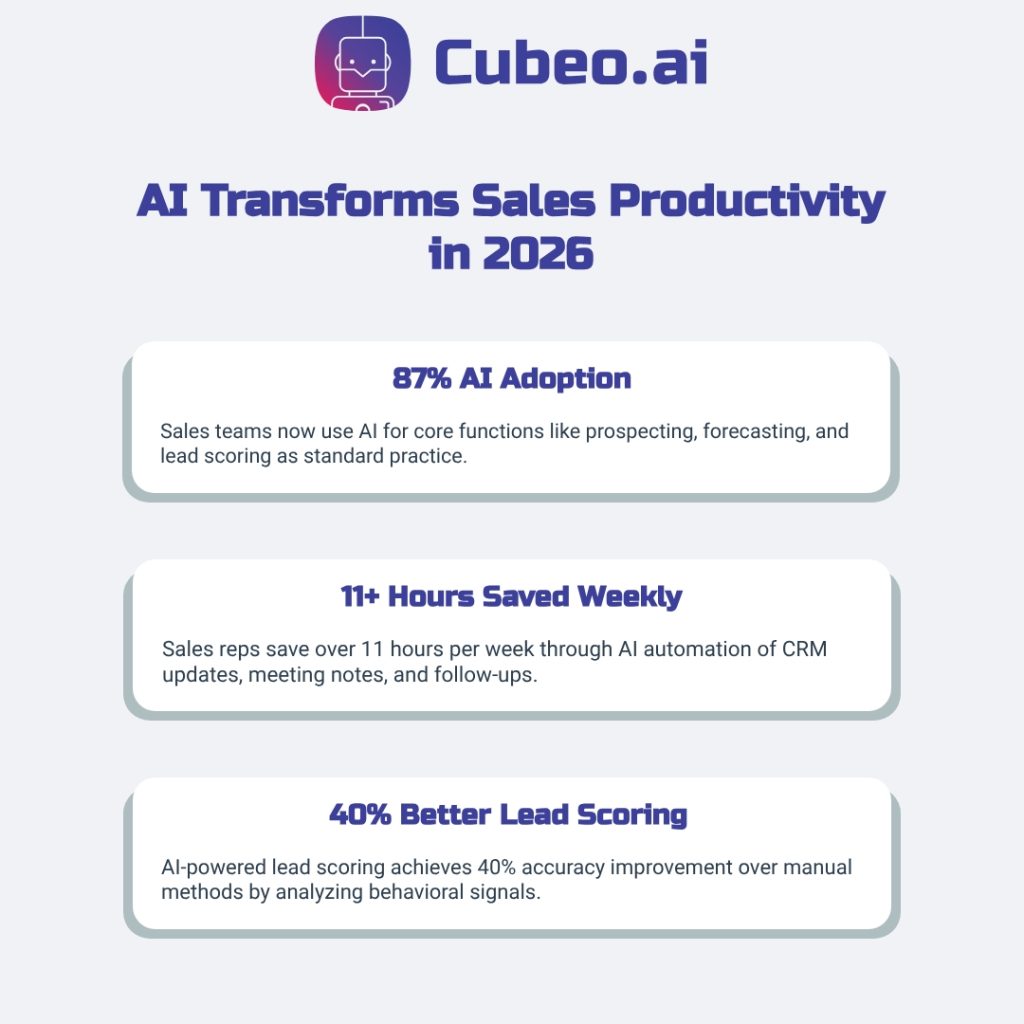
87% of Sales Teams Now Use AI for Core Enablement Functions
By 2026, AI stopped being experimental and became standard across sales stacks. Salesforce reports 87% of sales organizations now deploy AI for tasks like prospecting, forecasting, lead scoring, or drafting emails. High-performing teams report full integration rather than pilots.
Business implication: Budget conversations should assume AI presence rather than justify AI adoption. The real question now is deployment quality and measurable outcomes.
Sales Reps Save 11+ Hours Weekly with AI Automation
Sales professionals save an average of 2 hours and 15 minutes daily by automating CRM updates, meeting notes, and follow-up emails. That’s roughly 11 hours per week—about one extra rep for every four sellers without adding headcount.
Business implication: Reallocate recovered hours to prospect engagement rather than adding reps. Track pipeline velocity to verify time savings convert to revenue activity.
Administrative Tasks Reduced by 20-40% with AI Workflows
McKinsey research indicates automating non-customer-facing activities frees up about 20% of sales capacity, with leading implementations reporting reductions near 40%. Data entry, scheduling, and reporting shift to agent-based systems that handle repetitive logic reliably.
Business implication: Justify reallocation of enablement budgets from process management to coaching and quality oversight. Measure admin time reduction monthly as teams scale.
AI Lead Scoring Accuracy Improved by 40% Over Manual Methods
AI models identify high-intent prospects earlier by analyzing behavioral signals, firmographic fit, and engagement patterns. Organizations implementing AI-powered lead scoring achieve 40% accuracy improvements compared to manual or rule-based systems, reducing wasted outreach and improving focus on qualified pipeline.
Business implication: Better resource allocation to qualified opportunities means higher conversion per rep hour. Track false-positive rates to ensure models don’t narrow pipeline prematurely.
Reps Spend 30% Less Time Searching for Sales Content
Sales reps historically waste significant time hunting for relevant collateral. AI-powered recommendations match buyer stage, industry, and pain points, delivering materials in seconds. HubSpot research shows 79% of sales leaders say enablement materials are essential for closing deals, making faster content discovery directly valuable.
Business implication: Invest in content tagging and metadata structure so AI surfaces materials accurately. Poor taxonomy undermines recommendation engines and adoption rates.
New Rep Ramp Time Decreased by 22-29% with AI Coaching
AI-driven coaching provides real-time feedback on calls, emails, and pitch structure. Companies using AI for sales training reduce new hire ramp time by 22-29%, accelerating skill development and quota attainment timelines. Feedback happens in the moment rather than days later.
Business implication: Faster time-to-productivity reduces cost per hire and shortens the window before new reps contribute to the pipeline. Track quota attainment curves quarterly to verify impact.
Revenue Impact and Win Rate Improvements
Teams Using AI Enablement Report 15-25% Revenue Growth
Revenue separates pilots from production. Companies adopting AI sales enablement see 15- 25% revenue increases compared to 12% for teams without AI, driven by higher conversion rates and faster deal velocity. Case study outlier: TechFlow Inc. achieved 67% revenue growth in 9 months.
Win Rates Increase by 22% with AI-Powered Personalization
Hyper-personalization at scale increases win rates by 22% as AI analyzes buyer signals to tailor messaging and timing. Email open rates jump 43% and reps deliver stage-matched content instead of generic collateral. Personalized outreach scales without headcount expansion.
Business implication: Model 22% win-rate lift to estimate 0.2 FTE reduction per 10 reps after six months. Track win rates monthly by cohort to identify where AI amplifies performance fastest.
Average Deal Size Grows by 17% with AI Insights
AI identifies upsell and cross-sell opportunities earlier by analyzing usage patterns and engagement signals. Organizations report deal size increases of 15-30% as data-driven recommendations help reps position higher-value solutions at the right moment, increasing revenue per deal without extending sales cycles.
Business implication: Monitor average contract value monthly to verify upsell logic captures actual buying intent. Budget for 17% ACV growth baseline when modeling quota targets.
Sales Cycles Shortened by 30% with AI Sequencing
Automated follow-up sequences keep deals moving while AI prioritizes high-intent prospects for immediate engagement. Leading implementations report 30% reductions in sales cycle length. Faster deal closure improves cash flow and quarterly quota attainment directly.
Business implication: Track time-to-close by deal size segment weekly to ensure acceleration holds across tiers. Model 25% cycle reduction to estimate quarterly capacity gains per team.
Pipeline Conversion Rates Improve by 21% with AI Scoring
AI models predict which opportunities close, allowing teams to focus on high-probability deals. Forecast accuracy improves from 68% to 89% and teams detect deal risks two weeks earlier. Better pipeline quality translates to predictable revenue and higher conversion rates.
Business implication: Measure false-negative rates monthly to ensure models don’t filter viable opportunities prematurely. Budget for 20% conversion improvement when setting pipeline coverage ratios.
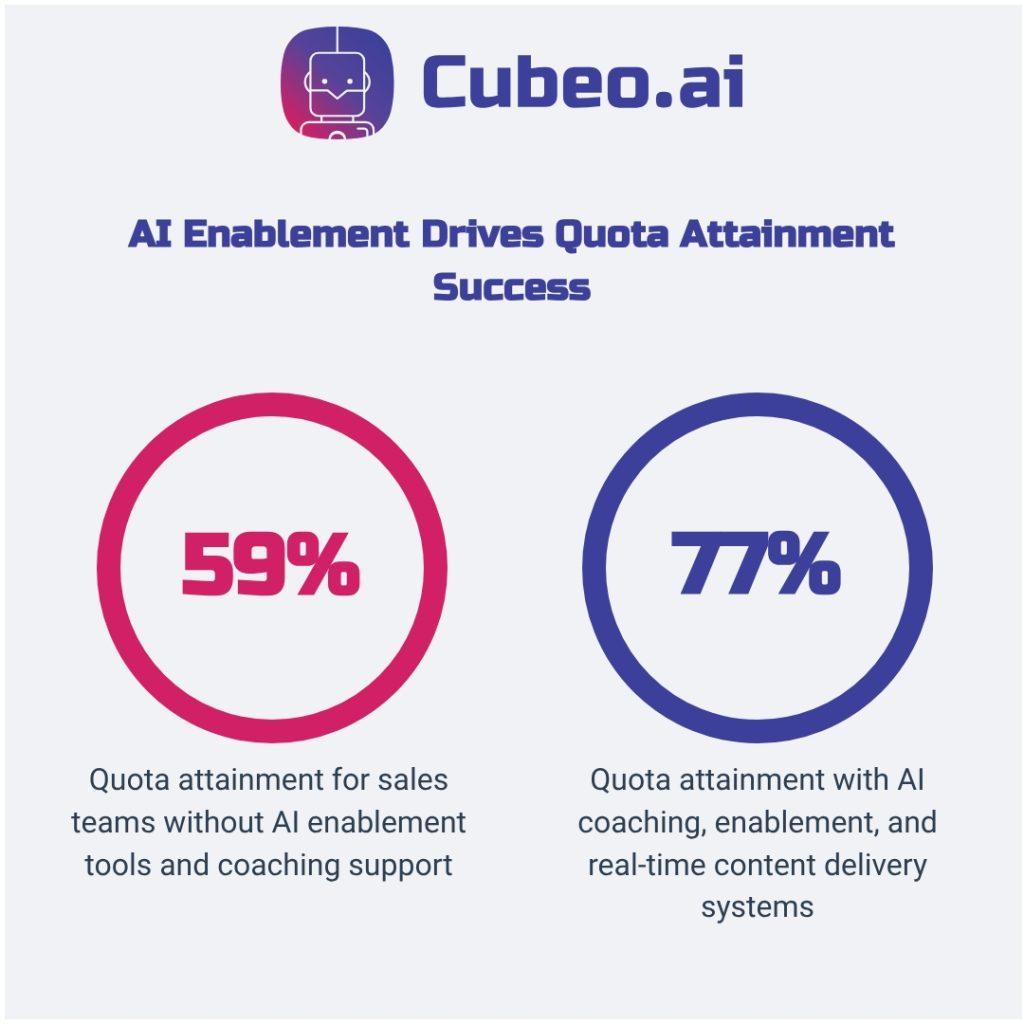
Quota Attainment Rises to 77% with AI Enablement vs 59% Without
AI coaching and enablement increase quota attainment from 59% to 77%, driven by better targeting, real-time coaching, and content delivery. This 18-percentage-point gap directly justifies investment. Reps using AI tools consistently hit numbers while peers without struggle.
Forecasting Accuracy and Data-Driven Decisions
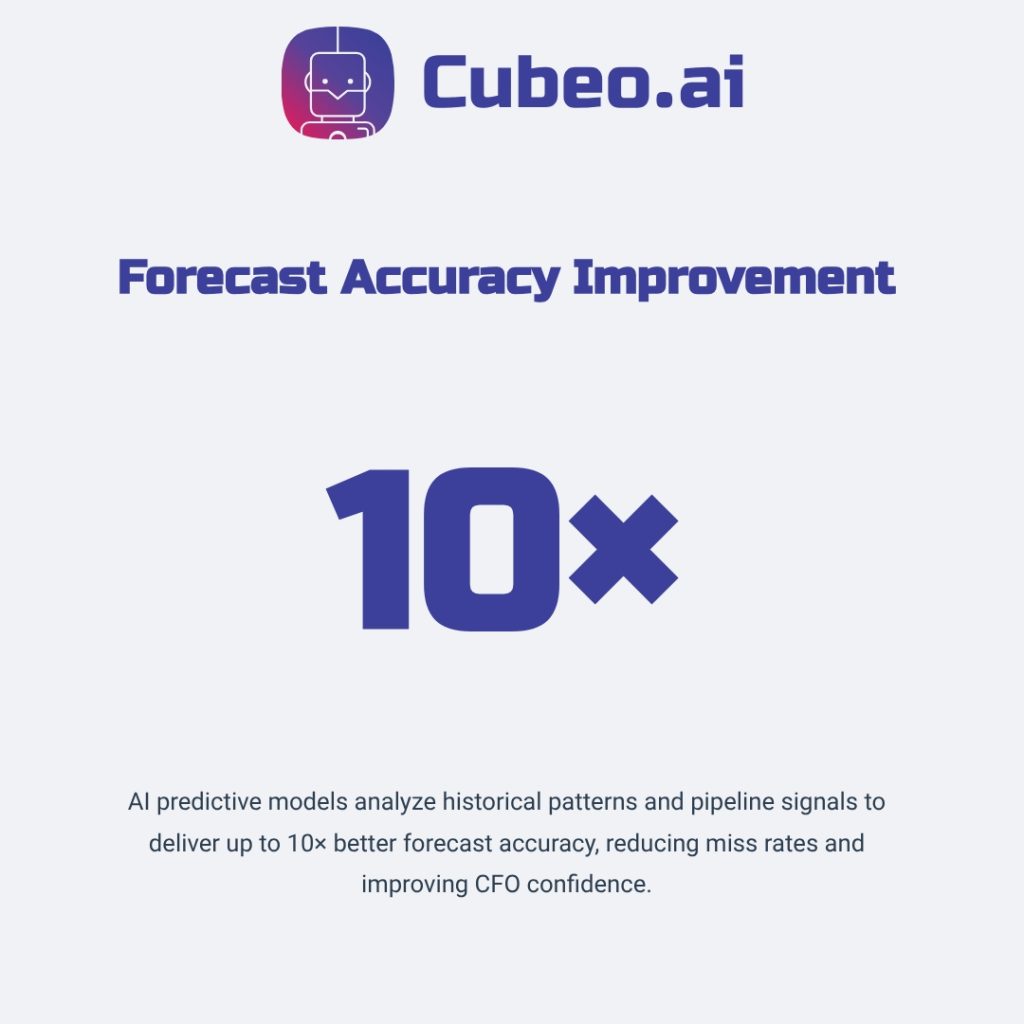
Forecast Accuracy Improves Up to 10× with AI Predictive Models
Predictable revenue matters more than growth promises. AI has improved sales forecast accuracy by up to 10× for companies using it to analyze deal data. AI analyzes historical patterns and current pipeline signals to predict outcomes, reducing forecast miss rates and improving planning confidence for CFOs.
80% of AI-Enabled Reps Get Insights Needed to Close Deals
Leaders trust AI-generated forecasts more than manual projections. AI-enabled reps report getting the insights needed to close deals at 80% rates vs 54% without AI. Real-time signals let you act faster than manual analysis, building executive confidence in revenue projections.
Business implication: Track confidence scores quarterly via leadership surveys. Budget for AI insight tools if fewer than 70% of your reps report adequate decision support.
Only 35% of Sales Professionals Fully Trust Their CRM Data
Clean data enables better forecasting and reporting. Only 35% of sales professionals fully trust their CRM data, but AI automation improves quality by flagging missing fields, enriching records, and reducing manual entry errors. Better data hygiene directly improves forecast reliability.
Business implication: Audit CRM completion rates monthly; set 90% field-completion targets. Prioritize AI automation over manual cleanup to sustain data quality as you scale.
Deal Risk Identified Two Weeks Earlier with AI Monitoring
AI flags at-risk deals based on engagement patterns and buyer signals, enabling proactive intervention. Systems detect deal risks two weeks earlier than manual reviews, giving you time to save deals before they slip. Companies report 20-40% faster deal acceleration after implementing AI monitoring.
Business implication: Define risk thresholds (e.g., no activity for seven days) and set automated alerts. Measure late-stage pipeline loss monthly to verify warnings and reduce churn.
75% of Companies Report Significant Forecast Accuracy Gains
Top-performing teams use AI dashboards for live pipeline visibility and faster responses to opportunity shifts. 75% of companies using AI for forecasting report significant accuracy improvements. Real-time insights become table stakes as adoption spreads across sales organizations.
Business implication: Establish weekly pipeline review cadence using real-time dashboards. Track time-to-insight (how quickly teams spot and respond to changes) as a leading indicator.
Sales Cycle Variance Reduced by 20-40% with AI Analytics
AI reduces the gap between forecasted and actual results, improving predictability for financial planning and resource allocation. Companies report 20-40% reductions in sales cycle variance after AI adoption. CFOs gain confidence in revenue projections when variance drops consistently quarter over quarter.
Business implication: Set variance reduction targets (aim for ±10% by quarter three). Report variance trends to your CFO monthly; consistent improvement justifies expanded AI budgets.
Coaching Effectiveness and Enablement Quality
AI Coaching Delivers 20% Higher Revenue Outcomes
Coaching quality determines whether reps develop or plateau. B2B companies using AI coaching report 20% higher revenue outcomes. Separately, Outdoo finds win rates improve by 36% where coaching scales consistently.
Business implication: Budget 15–20% more for coaching tools. 19% of teams see ROI in three months; 27% within 6–12 months.
Training Completion Rises When AI Personalizes Learning Paths
Automated reminders and personalized learning paths improve engagement by adapting content to rep performance and learning pace. Teams typically see payback within 3–6 months as completion rates rise and reps apply skills faster in live selling situations.
Business implication: Track completion rates weekly by cohort. If completion falls below 85% after six months, reallocate 10–15% of coaching budget to content remediation or vendor tuning.
Personalized Coaching Improves Rep Engagement Quality
AI tailors coaching based on rep behavior and skill gaps, improving relevance rather than delivering generic feedback. Structured coaching programs yield 28% higher win rates when AI identifies specific improvement areas and recommends targeted practice.
Business implication: Shift 20% of enablement budget toward AI-enabled personalization. Monitor coaching engagement scores by rep segment monthly to verify AI-enabled programs outperform traditional approaches.
Buyer Experience Improves When Reps Leverage AI Insights
Buyers report better experiences when reps use AI-powered insights for timely, relevant interactions. AI coaching integrates with CRM and conversation intelligence to enhance buyer journey quality, reducing friction and building trust throughout the sales cycle.
Business implication: Survey buyers quarterly on engagement quality. Track NPS or satisfaction scores by rep segment to verify AI-enabled reps deliver measurably better experiences than peers.
AI Matches Content to Buyer Context Automatically
AI matches content to buyer stage, industry, and pain points so reps deliver relevant materials in every interaction. AI tools integrate with CRM for actionable content recommendations, driving higher adoption and deal progression as materials hit the mark more often.
Business implication: Measure content usage rates monthly. Target 70% adoption for recommended materials; low usage signals poor tagging or irrelevant recommendations needing tuning.
Conversation Intelligence Adopted by 78% of Organizations
AI analyzes calls and emails to surface coaching opportunities and provide actionable insights for rep improvement. 78% of organizations now use AI in business functions, including conversation intelligence that scales coaching across large teams without adding manager headcount.
Business implication: Implement conversation intelligence for teams above 15 reps. Aim for 1 manager per 12 reps (vs typical 1:8) and report ratios monthly.
AI Investment Trends and Strategic Priorities for 2026
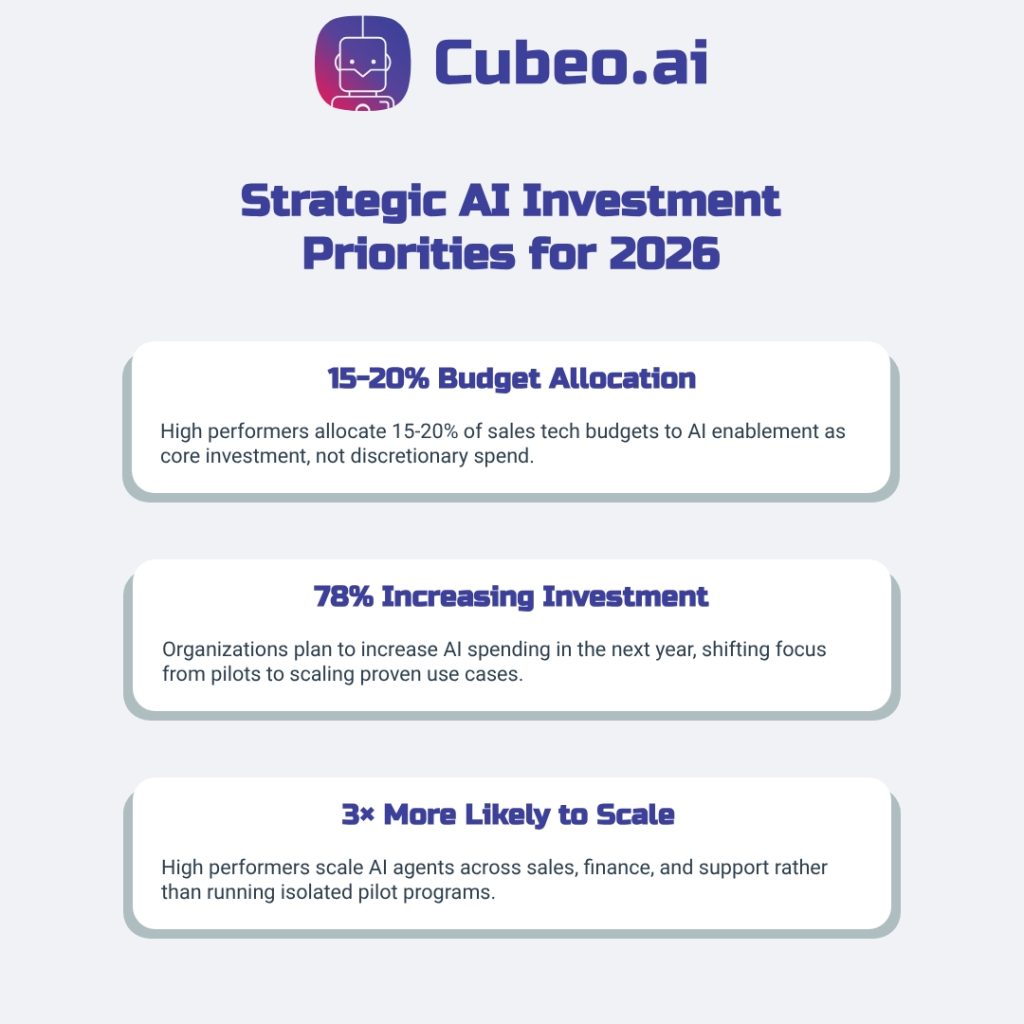
Allocate 15–20% of Sales Tech Budgets to AI Enablement
Assume AI is a core line in your sales tech budget, not discretionary spend. 88% of organizations now report regular AI use in at least one function, yet only 33% have scaled enterprise-wide. Over one-third of high performers allocate more than 20% of digital budgets to AI.
Leading Implementations See Payback Within 12–18 Months
ROI timelines drive investment confidence. Leading implementations often achieve payback within 12–18 months when paired with strong change management. 39% of organizations report some EBIT impact from AI, though most contributions remain below 5% as teams scale from pilots to production.
Business implication: Budget for 12–18 month payback when modeling AI investments. Track incremental revenue gains quarterly; positive ROI before month 12 indicates strong execution and justifies expansion budgets.
Agent Orchestration Consolidates Tools and Cuts Integration Overhead
62% of organizations experiment with AI agents, with 23% scaling agentic AI in at least one function. Agent orchestration — think of a conductor coordinating small, purpose-built AI agents — replaces disconnected point tools, cutting integration overhead and license sprawl.
Business implication: Map your current tool inventory. Target 30–40% consolidation over 18 months by replacing 3–5 point solutions with orchestrated agent patterns; track licensing savings monthly.
High Performers Are 3x More Likely to Scale AI Across Functions
Usage intensity predicts performance. High performers are 3 times more likely to scale AI agents across sales, finance, and support rather than running isolated pilots. Daily AI usage correlates directly with quota attainment and deal velocity.
Business implication: Track AI feature usage weekly by rep. If fewer than 60% use AI tools daily after three months, investigate training gaps or usability issues blocking adoption.
C-Suite Leaders Engage with AI Regularly, Driving Adoption
Executive engagement reaches new levels. 53% of C-suite leaders interact with Gen AI regularly at work, demonstrating hands-on commitment rather than delegated oversight. High performers are three times more likely to report strong senior leadership ownership of AI initiatives.
Business implication: Board-level support for AI enablement is now mainstream. Present quarterly AI ROI updates to the board; strong executive engagement accelerates approval for expanded budgets.
78% of Organizations Plan to Increase AI Investment in Next Year
Future intent signals continued market maturation. 78% of organizations plan to increase AI spending in the next 12 months, with focus shifting from pilots to scaling proven use cases. The global AI market projects 35.9% CAGR through 2030, reaching $1.81 trillion.
Business implication: Early movers gain competitive advantage before market saturation. Lock in vendor partnerships now; pricing and implementation timelines will tighten as demand accelerates through 2026–2027.
FAQ
What percentage of sales teams are using AI in sales enablement in 2026?
By the end of 2026, 80% of sales teams are projected to be using AI in sales enablement, with some reports indicating that 81% are already leveraging it today. This isn’t just a trend; it’s a fundamental shift in how sales organizations operate.
AI is moving beyond simple assistance to actively executing complex tasks, driving tangible impact. This integrates traditional enablement with advanced technologies like machine learning and generative AI, connecting content, workflows, and customer data to proactively identify opportunities and deliver precise messaging. The imperative here is clear: deploy AI strategically, not reactively, to gain a competitive edge. It’s about building production-ready systems incrementally, ensuring reliability and measurable outcomes, rather than hoping for a “big bang” transformation.
This widespread adoption signifies that AI is now a critical component for competitive advantage. Sales organizations are building AI-augmented strategies that seamlessly blend human sellers with technology, creating more customer-centric buying experiences. The focus is squarely on automating the repetitive, low-value work to free up human creativity and strategic thinking.
How much does AI improve sales productivity and quota attainment?
AI significantly enhances sales productivity, with teams experiencing up to 44% higher productivity, a 15% increase in conversion rates, and 45% more deals closed when leveraging AI and machine learning tools. Quota attainment can see a substantial boost, ranging from 18% to 41% with the strategic integration of AI and sales technology.
The core problem AI solves here is the massive time sink in manual tasks. Sales reps often spend a significant portion of their day on administrative work rather than actual selling. By automating these labor-intensive activities—like data entry, content searching, and email drafting—AI frees up valuable selling time, allowing reps to concentrate on high-value interactions and relationship building. This direct impact reduces sales cycles by 27% and increases actual selling time by 40% for companies deploying AI in their sales processes. Furthermore, teams with AI enablement are 2.4 times less likely to feel overworked, ensuring a more sustainable and productive environment.
This isn’t about AI replacing the human element; it’s about empowering your team to achieve previously unattainable revenue targets. The system handles the grunt work, enabling your sellers to focus on what they do best: building connections and closing deals. However, for these results to materialize, a balanced investment in both technology and the people and processes around it is crucial. Organizations that prioritize a 70% investment in people and processes alongside technology achieve 1.5 times higher revenue growth.
What are the top AI use cases in sales enablement for 2026?
In 2026, the top AI use cases in sales enablement are firmly centered on operationalizing AI to execute tasks rather than just assisting. Key applications include real-time coaching, advanced lead scoring, and hyper-personalized content delivery, with AI deployed across the entire sales enablement journey to provide actionable deal insights and direct guidance to sales representatives.
The shift is from a “copilot” to an “agent” mindset: AI is now drafting full business cases, populating account plans, and automating follow-ups directly. Core capabilities include automatic logging of emails, meetings, and calls to CRM, AI-driven deal and pipeline analytics, sophisticated engagement scoring, buyer mapping, and real-time coaching insights derived from rep activity and conversion rates. Platforms like Spekit deliver in-app guidance by learning from rep behavior, while ZoomInfo leverages AI for comprehensive B2B data and buyer intent signals. Gong, on the other hand, excels in conversation intelligence, providing call analysis and coaching.
This isn’t about “cool” AI; it’s about production-ready AI automation that moves business metrics. Our focus is on making these powerful capabilities accessible to sales and operations teams, without requiring them to become prompt engineers. This means building systems with robust guardrails, continuous validation, and real-time monitoring to ensure consistent, reliable performance and measurable impact on cycle time, throughput, and conversion rates.