
You build a lead qualification agent. It scores prospects perfectly in testing. Then it hits production: incomplete company data, missing emails, prospects with no LinkedIn profiles. The agent either rejects everything or qualifies garbage. That gap between demo and production kills most implementations.
This guide covers how to build a system that works on real data.
What Is AI-Powered Lead Qualification?
AI-powered lead qualification uses autonomous AI agents to research, enrich, and score prospects against your ideal customer profile automatically. Unlike manual scoring, AI agents analyze hundreds of data points per lead, update scores as new signals arrive, and route qualified prospects to your CRM without human review.
The key distinction: these are not chatbots. AI agents perceive (analyze lead data), decide (score against ICP criteria), and act (route to sales or nurture). A chatbot waits for input. A qualification agent runs the moment a new lead enters your system.
Traditional lead scoring uses static rules: “if company size > 100 and industry = SaaS, score +20.” Those rules go stale. AI scoring learns from your historical conversion data and adjusts thresholds as patterns shift. According to Demandbase’s guide to AI lead scoring, AI systems continuously train on outcomes and adjust thresholds automatically, which static rule sets cannot do.
Modern AI-driven lead qualification systems integrate data from multiple sources and score based on hundreds of signals simultaneously. Cubeo AI’s Lead Scorer Agent assigns 0-100 scores based on ICP fit and engagement signals, with dynamic re-scoring as new data arrives.
Why Manual Lead Qualification Breaks at Scale
Sales reps spend 70% of their time on activities that don’t involve selling. Manual prospecting and qualification account for 6+ hours per week per rep, spent copying data between tools, checking LinkedIn profiles, and debating whether a lead meets criteria that aren’t written down anywhere.
Three failure modes make manual qualification unsustainable as your pipeline grows.
Inconsistent criteria. When qualification lives in reps’ heads, every rep qualifies differently. One rep passes a 50-person company. Another rejects it. Your pipeline data becomes meaningless.
Data decay. CRM contacts go stale at 30-50% annually. A lead that was perfect six months ago may have changed jobs, company size, or tech stack. Manual processes can’t keep up with that rate of change.
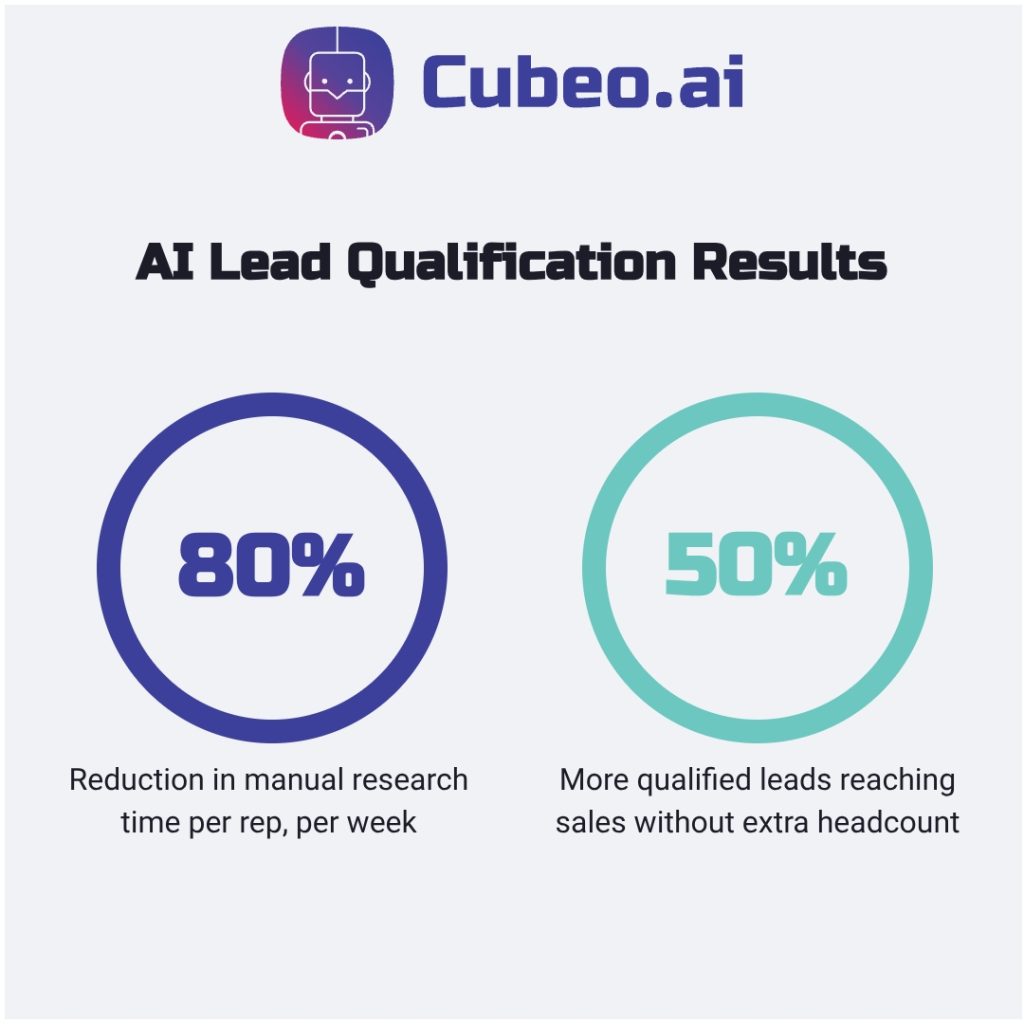
Volume ceiling. A rep can review 20-30 leads per day with any real attention. AI agents process thousands. Teams that automate sales prospecting see 50% more qualified leads and 80% reduction in research time, because the bottleneck shifts from human attention to data quality.
The goal is to stop wasting rep judgment on leads a scoring model can handle in seconds.
How a Multi-Agent Qualification System Works
Traditional automation runs scripts. AI agents make decisions. That difference matters when your lead data is messy, which it always is in production.
A production-ready qualification system uses four specialist agents in sequence.
Stage 1: Discovery. The Lead Finder Agent discovers prospects matching your ICP criteria automatically, searching LinkedIn, company databases, and web sources.
Stage 2: Enrichment. The Lead Enrichment Agent fills missing data: company size, tech stack, LinkedIn profiles, verified email addresses. Fifty percent of reps abandon leads when profiles are incomplete. Enrichment solves that before scoring runs.
Stage 3: Scoring. The Lead Scorer assigns a 0-100 score based on ICP fit, behavioral data, and buying signals. Leads above your threshold go to sales. Leads below go to nurture.
Stage 4: Routing. Qualified leads land in your CRM with full context. No manual sorting required.
A multi-agent lead management system coordinates these specialists so each agent handles one job well. Use event-based triggers to fire the pipeline automatically when a new lead enters your CRM.
When we rebuilt our own 18-agent system on Cubeo, failures were almost always in the handoffs. Enrichment data that didn’t pass cleanly to the scorer. Routing logic that broke on edge cases. Building the relay race is harder than building any individual agent.
Implementation Best Practices (and Where Teams Go Wrong)
Most teams configure a scoring agent before defining what a qualified lead looks like. The agent runs, produces scores, and nobody trusts the output because the criteria were never agreed on.
Four steps that prevent this.
Step 1: Define ICP criteria first. Write down the exact attributes that make a lead qualified: company size, industry, tech stack, job title, engagement signals. Get sales and marketing to agree before touching any tool.
Step 2: Audit your data quality. According to IBM’s research on data quality, data inconsistency and completeness are the top reasons AI systems fail in production. Find the fields that are missing or stale before scoring runs.
Step 3: Build human-in-the-loop checkpoints. For high-value leads, build human-in-the-loop checkpoints so reps review before the agent routes. Full autonomy without guardrails is irresponsible. Cubeo’s HubSpot integration shows how to implement approval gates in a production CRM.
Step 4: Start with one workflow. A good ML lead scoring implementation requires clear objectives and performance monitoring from day one. Expanding before validating the first workflow multiplies your problems.
The most common failure: skipping enrichment and scoring on incomplete profiles. Garbage in, garbage out.
Measuring What Matters: KPIs for AI Lead Qualification
After a sales call with a prospect, I identified my own mistake: I’d been selling features instead of outcomes. The same trap applies to measuring lead qualification systems. Teams track “leads processed” instead of “qualified leads that converted.”
Four metrics that tell you whether the system is working.
Lead-to-SQL conversion rate. What percentage of AI-qualified leads become sales-qualified opportunities? Measure before and after. If the rate doesn’t improve, scoring criteria need adjustment.
Time-to-qualification. Weekly hours each rep spends on manual qualification. Teams using AI lead qualification see 50% more qualified leads and 80% reduction in research time.
Qualification accuracy rate. What percentage of AI-qualified leads actually convert? Track monthly and adjust thresholds when accuracy drops.
Cost per qualified lead. Total platform cost divided by qualified leads generated. An ROI measurement framework for AI sales automation tracks CPL, CPO, and hours saved per rep. AI sales tools ROI metrics show teams typically see 25% cost savings and 30% higher productivity.
Set a 30-day baseline. Measure the same metrics after 30 days of AI qualification. The delta is your ROI story.
Take Away
- AI lead qualification uses autonomous agents to research, enrich, and score prospects against your ICP automatically, routing qualified leads to your CRM without manual review
- SDRs spend 6+ hours per week on manual qualification; AI cuts this to near zero while processing thousands of leads simultaneously
- Multi-agent pipelines (Lead Finder, Enrichment, Scorer, Routing) outperform single-agent setups because each specialist handles one job well, reducing handoff errors
- Start with ICP definition and a data quality audit before configuring any agent; scoring on incomplete profiles produces unreliable results
- Measure lead-to-SQL conversion rate, time-to-qualification, and qualification accuracy rate to prove ROI within 30 days of deployment
Frequently Asked Questions
What is the difference between lead scoring and lead qualification?
Lead scoring assigns a numerical value (0-100) to prospects based on ICP fit and engagement signals. Lead qualification is the binary decision: does this lead go to sales or nurture? Scoring is continuous and automated. Qualification is the decision point. Most AI systems use scoring as the primary input to qualification, with thresholds you define based on historical conversion data.
How do you implement lead scoring in your CRM?
Implementing lead scoring in your CRM requires four steps: (1) Define ICP criteria including company size, industry, tech stack, and behavioral signals. (2) Audit data quality and enrich missing fields. (3) Configure scoring rules or train an AI model on historical conversion data. (4) Set up routing workflows to send qualified leads to sales automatically. Data quality is the step most teams skip.
How long does it take to set up an AI lead qualification system?
Most AI lead qualification systems can be configured in 2-4 hours using no-code platforms like Cubeo AI. ICP definition and data quality audits take the most time. Agent configuration and trigger setup are fast once criteria are clear. Teams typically see qualified leads flowing within the first week, with ongoing work focused on monitoring accuracy and adjusting thresholds.