
These 25 AI in e-commerce statistics give you concrete benchmarks to prioritize spend and measure pilots. We selected each stat for decision utility: credible sources, large samples (typically n>200), and outcomes tied to conversion, revenue, retention, or operational efficiency.
We filtered for impact, not volume. Each statistic maps to one of 15 outcome areas (for example: personalization ROI, support deflection, forecast accuracy).
Scan headings for your priority area. Read the stat block. Act on the implication.
This is executive-ready decision support, production-grade AI e-commerce benchmarks you can cite in budget and vendor conversations. Measurable outcomes drive every selection, not vendor pitches or vague predictions.
AI Adoption and Market Growth in E-commerce
Five benchmarks you can cite in budget requests and vendor RFPs. Adoption rates, spending commitments, and traffic surges show AI has moved from experimental testing to operational necessity across e-commerce.
AI-enabled e-commerce market hits $8.65B in 2025 with long-term growth to $22.6B
Market valuation reached $8.65 billion in 2025 and projects to $22.6 billion by 2032, growing at 14.6% annually. This sustained trajectory signals validated demand rather than hype cycle volatility. North America leads spending due to prioritized AI budgets across retail and consumer goods sectors.
Action: Use validated growth at this scale to justify multi-year AI investment as strategic infrastructure, not experimental project.
78% of organizations use AI in at least one business function, up from 55% in 2023
Adoption jumped from 55% to 78% in two years. Organizations now deploy AI across customer service, inventory optimization, and personalization workflows. This shift marks AI’s transition from pilot programs to operational deployment.
Action: If you haven’t deployed AI for core workflows like search, personalization, or support, you’re falling behind competitive parity.
97% of retailers plan to increase AI spending in next fiscal year
HelloRep and NVIDIA research shows 97% of retailers plan spending increases. Executives allocate budget expecting measurable returns in conversion, retention, and cycle-time reduction. This near-universal commitment reflects AI’s shift to infrastructure status.
Action: Frame budget proposals around specific outcome metrics like conversion lift or cost per-task reduction to secure funding faster.
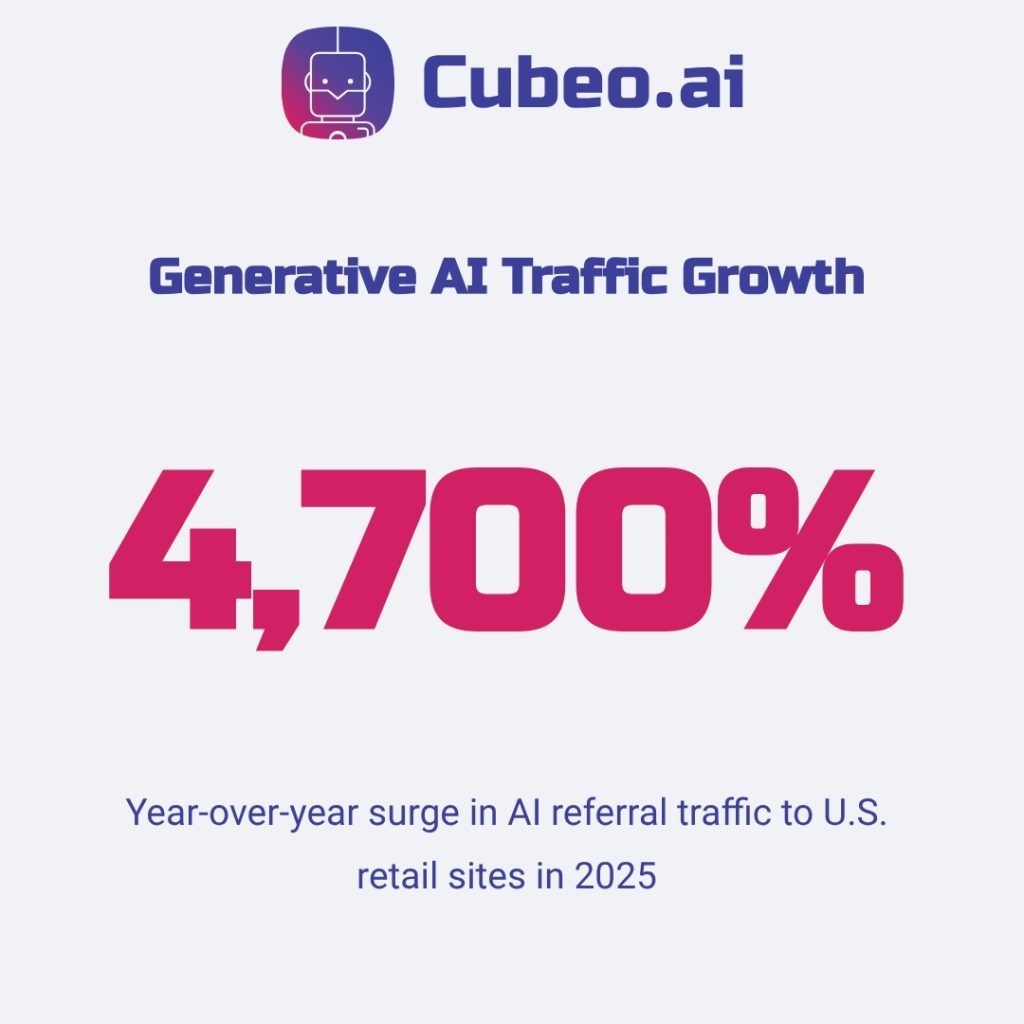
Generative AI referral traffic surged 4,700% year over year
Adobe Digital Insights documented 4,700% year-over-year growth in generative AI traffic to U.S. retail sites through mid-2025. Shoppers arriving from AI sources show 10% higher engagement, longer visits, and lower bounce rates compared to traditional search traffic.
Action: Launch a content pilot to optimize product pages for AI discovery patterns.
84% of e-commerce businesses rank AI as their highest strategic priority
Bloomreach’s survey of 800 e-commerce leaders found 84% rank AI as top priority. Organizations delaying implementation risk market position as AI-enabled competitors gain advantages in personalization, pricing, and operational speed. This prioritization reflects competitive necessity, not curiosity.
Action: Start with one high-ROI use case, measure impact after 6–12 weeks, then scale — delayed action costs more than failed pilots.
AI Impact on Conversion and Revenue Performance
AI personalization and conversational tools drive conversion uplifts between 4X and 23%, translating traffic into completed transactions and higher customer lifetime value. Five revenue benchmarks you can cite in budget requests and vendor conversations.
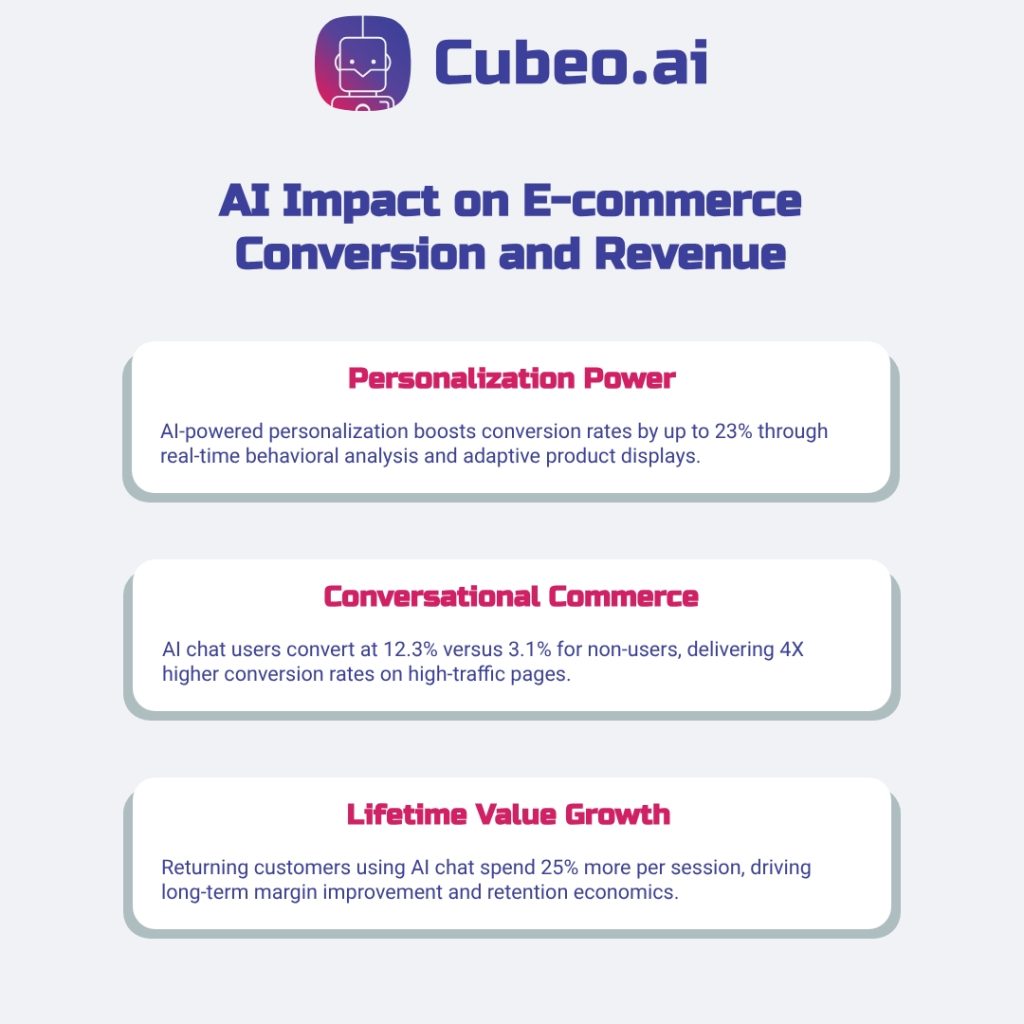
AI-powered personalization boosts conversion rates by up to 23% through real-time analysis
AI personalization lifts conversion rates up to 23% by adapting product displays, recommendations, and messaging to individual shopper behavior. This improvement transforms marginal traffic into profitable customers. Organizations deploying personalization at scale typically see measurable gains within 8–12 weeks.
Action: Launch a Q2 personalization pilot with segment-level A/B testing; target a minimum 10–15% conversion uplift in your highest-traffic cohorts within 12 weeks.
Conversational AI delivers 4X higher conversion rates compared to standard experiences
AI chat users convert at 12.3% versus 3.1% for non-users, a 4X improvement. This delta alone pays back chatbot implementation within months on high-traffic category pages. Product detail and checkout pages see the strongest returns when AI assists navigation and answers pre-purchase questions.
Action: Deploy conversational AI on your top 10% traffic pages first; measure conversion delta within an 8-week A/B window and require a minimum 2% absolute uplift to justify scaling.
Shoppers complete purchases 47% faster when assisted by AI tools
Purchase completion accelerates 47% with AI assistance compared to manual navigation. Speed reduces cart abandonment by eliminating friction during product discovery and checkout. Faster paths improve completion rates, particularly for mobile shoppers facing time constraints or complex product catalogs.
Action: Implement AI-powered checkout optimization and track completion rate improvements within 30 days; target a 15–20% reduction in cart abandonment rate.
Returning customers spend 25% more when using AI chat during sessions
Returning customers using AI chat spend 25% more per session compared to non-assisted visits. AI increases lifetime value beyond initial acquisition by surfacing relevant upsells and answering questions faster. This lift compounds across multiple purchases, driving long-term margin improvement and retention economics.
Action: Prioritize AI deployment for logged-in repeat customers; measure average order value and purchase frequency delta over a 90-day cohort to validate lifetime value gains.
AI optimization increases average order value by 15-30% across product categories
Dynamic bundling and upselling algorithms drive basket values higher by suggesting complementary products at optimal moments. AI analyzes purchase patterns in real time to recommend bundles customers actually want, lifting average order value by 15–30% depending on category mix and implementation depth.
Action: Deploy AI-driven product bundling on high-margin categories first; track basket composition changes weekly and refine algorithms based on acceptance rates to maximize revenue per transaction.
AI-Driven Personalization and Customer Experience
91% of consumers more likely to shop with brands providing personalized experiences
Consumer preference for personalization reached 91% among U.S. shoppers. Additionally, 66% stop buying from sites lacking tailored experiences. Personalization is required for competitive retention; treat it as baseline capability.
Action: Audit your current personalization capabilities within 30 days; if you’re delivering generic experiences to logged-in customers, prioritize a segmentation pilot targeting your top 20% revenue cohort.
Recommendation engines drive 35% of revenue for leading e-commerce platforms
Amazon generates 35% of total revenue from its recommendation engine. Customers engaging with recommendations spend 29% more per session and show 73% higher lifetime value. Other major platforms report similar gains when deploying AI-powered product suggestions at scale.
Operator note: Expect a 6–12 week engineering window to productionize recommendations if your product taxonomy or clickstream data is immature.
Target: 15–20% revenue share from recommendations — deploy or upgrade on product detail pages and measure contribution over 90 days.
71% of consumers feel frustrated when shopping experience lacks personalization
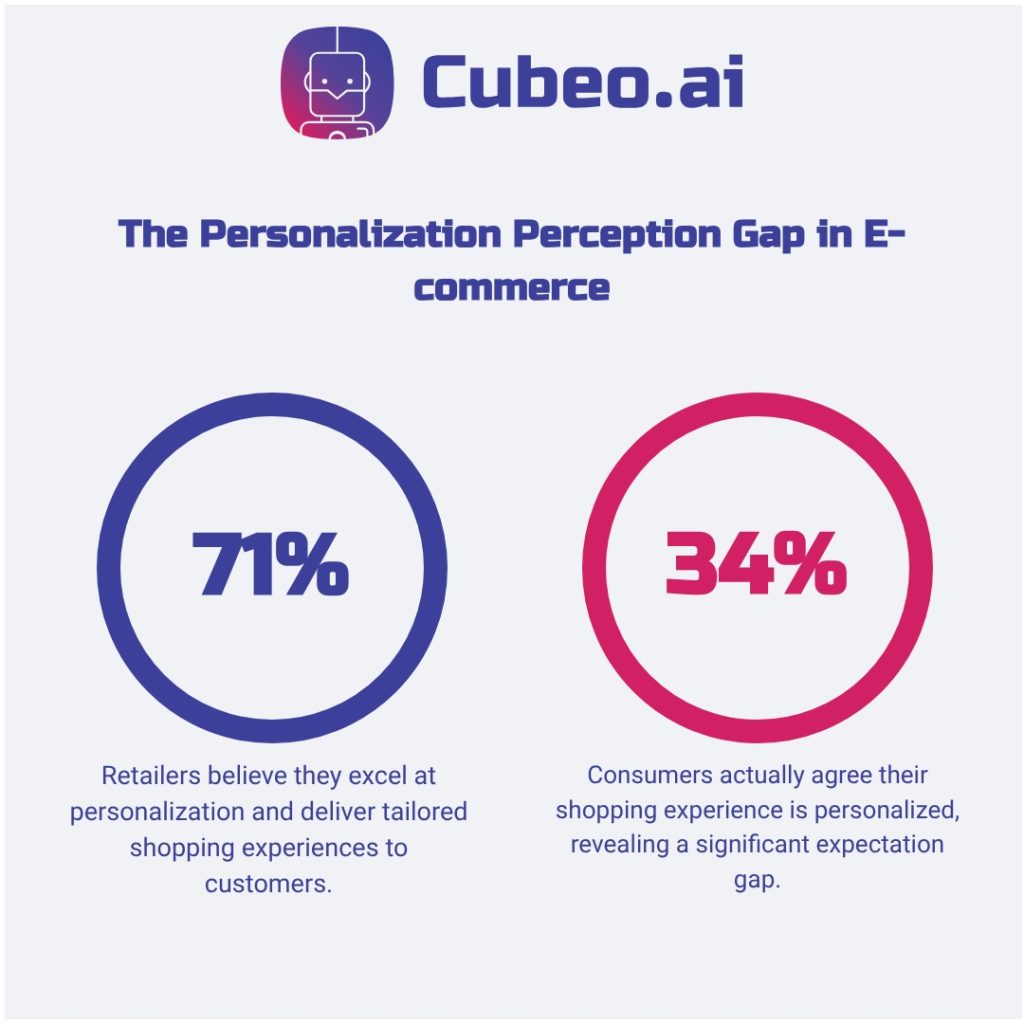
A perception gap exists: 71% of retailers believe they excel at personalization, yet only 34% of consumers agree. This disconnect creates friction and drives shoppers to competitors offering better-tailored experiences. Data-driven personalization closes this expectation gap.
Action: Survey a sample of your customers within 60 days to measure actual satisfaction with personalization; use that baseline to prioritize investments in real-time behavioral targeting.
78% of consumers more likely to make repeat purchases from personalized brands
Personalization drives retention economics: consumers who receive tailored experiences are 78% more likely to make repeat purchases. This reduces customer acquisition costs over time by increasing lifetime value and lowering churn rates for existing customers.
Action: Focus personalization investments on repeat customer touchpoints (email, app, account pages); track repeat purchase rate and average time-to-second-purchase over a 6- month cohort.
Visual search usage increased 70% globally with 4B monthly searches on Amazon
Visual search usage grew 70% globally, with Amazon processing 4 billion monthly visual searches. Younger shoppers lead adoption: 22% of 16–34 year-olds use visual search regularly. This emerging interface requires platform support to capture mobile-first audiences.
Action: Pilot visual search within 6 months if your audience skews younger or fashion/home goods focused; measure adoption rate plus conversion delta versus text search.
Operational Efficiency and Cost Optimization Through AI
AI pilots typically free millions in working capital and reduce per-order logistics costs by double digits.
Many e-commerce teams automate product content generation, pricing adjustments, and inventory allocation through workflow orchestration systems, reducing manual tasks by 40+ hours per week while maintaining quality controls.
Over 80% of supply chain leaders plan AI deployments for forecasting and inventory
Over 80% of supply chain leaders plan AI deployment for demand forecasting, inventory management, and network design in 2026. Two-thirds already rolled out cloud infrastructure to support these capabilities. Supply chain AI adoption has reached critical mass, with integration into inventory systems delivering competitive advantage.
Pilot AI forecasting on your high-volume SKUs first; measure stock-out reduction and forecast error over 90 days. Target 30–50% forecast error reductions in mature implementations.
AI supply chain tools reduce logistics costs 15% on average, up to 50% in optimized operations
Logistics costs drop by 15% on average from better routing and predictive insights, with exceptional programs achieving up to 50% savings over time. Savings compound through route optimization, load consolidation, and demand prediction. Predictive maintenance cuts downtime by 50% and maintenance costs by 25%.
Start with your highest logistics cost segment (routing, warehouse labor, or freight consolidation). Pilot AI optimization there and track cost-per-unit-shipped weekly to measure ROI.
AI-driven forecasting reduces inventory levels 20-35% while maintaining service quality
Companies using AI-driven inventory systems achieve 20-35% reductions in inventory levels while increasing service levels by 65%. Forecasting errors drop 20–50%, enabling leaner operations that free working capital for growth investments. Carrying costs decline while stock-out rates improve.
If you carry $5M inventory, a 25% reduction frees $1.25M in working capital. Deploy that capital to marketing, product development, or margin improvement initiatives and measure inventory turn rate monthly.
AI chatbots resolve 93% of customer questions without human agent escalation
AI chatbots resolve 93% of customer questions without escalation, reducing support costs by 30% while improving response times. Organizations deploying chat automation report first-contact resolution rates above 70%. If you haven’t piloted support automation, start with your top support use cases; 54% of peers already have deployments.
Target 70%+ first-contact resolution within 8 weeks of chatbot deployment. Measure ticket volume, escalation rate, and customer satisfaction score weekly to validate ROI.
Proactive AI chat recovers 35% of abandoned carts through timely intervention
Proactive AI chat recovers 35% of abandoned carts by engaging shoppers at friction points during checkout. Cart abandonment remains persistent; proactive outreach recaptures significant lost revenue by answering questions, offering incentives, or clarifying shipping options in real time.
Enable proactive chat on cart and checkout pages for orders above your average order value. Measure cart recovery rate and incremental revenue over 60 days to prove impact.
ROI, Implementation Success, and Future Outlook
Investment outcomes and deployment realities shape strategic planning. These five benchmarks validate the business case for AI while highlighting gaps between pilot success and enterprise-scale implementation.
69% of retailers implementing AI report direct revenue increases
Sixty-nine percent of retailers implementing AI report direct revenue increases. Additionally, 72% report cost reductions, creating dual economic benefit. This strong majority experiencing measurable gains validates AI investment decisions.
Use the 69% benchmark to request a 2-year pilot budget tied to target revenue uplift. Track top-line revenue lift and cost reduction separately with quarterly checkpoints tied to deployment milestones.
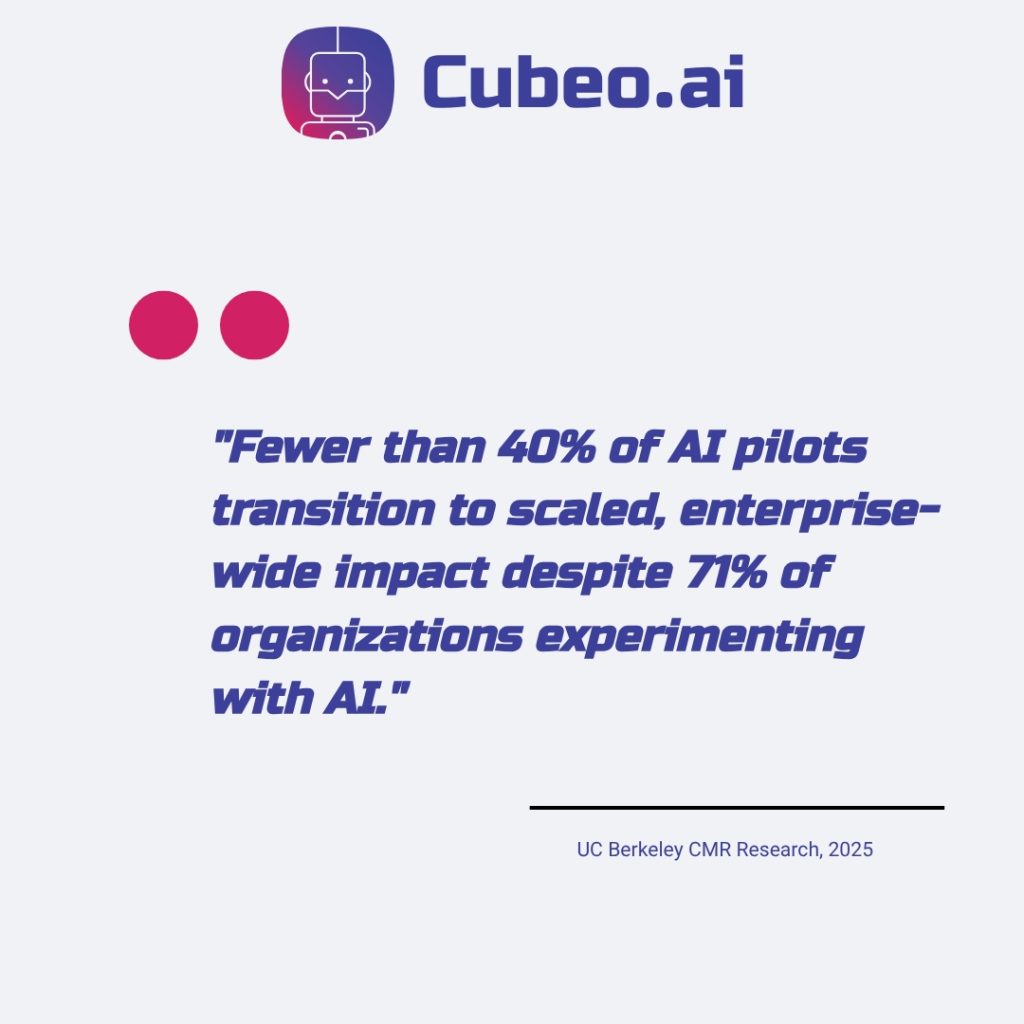
Implementation gap persists: 71% tried AI but fewer than 40% scale pilots enterprise-wide
Fewer than 40% of AI pilots transition to scaled, enterprise-wide impact despite 71% of organizations experimenting with AI. This gap between pilot success and production deployment represents opportunity for organizations building governance, accountability, and workflow redesign into roadmaps from day one. Comprehensive rollouts typically require 6–12 months.
Require vendor SLAs for model monitoring, audit logs, and incident response in RFPs. Set measurable KPIs at each phase gate to close the gap.
53% of retail managers identify data security as top AI implementation barrier
Data security concerns remain the primary obstacle, cited by 53% of retail managers. Platforms with strong security credentials, compliance certifications, and audit trails accelerate adoption by reducing approval friction and shortening vendor evaluation cycles.
33% of e-commerce enterprises expected to deploy agentic AI by 2028
Autonomous AI systems (multi-step systems executing complex tasks without human triggers) represent the next evolution, with 33% of e-commerce enterprises expected to deploy agentic AI by 2028, up from less than 1% today. These systems will handle dynamic pricing adjustments, inventory reordering, and personalized campaign orchestration independently.
Run a 6–12 week pilot automating reorder rules on your top 100 SKUs. Measure forecast error and stockout rate weekly; require human-in-loop thresholds, rollback SLAs, and monitoring dashboards before scaling.
AI demand forecasting reduces forecast errors by 30-50% and cuts stockout losses by 65%
AI-powered demand forecasting improves short-term accuracy by 25% and first-month accuracy by 20%, with forecast deviations dropping to 1% against stable targets. Analyst time spent generating forecasts drops by 40%. Mature implementations achieve 30–50% error reductions and cut stockout-related lost sales by 65%.
Predictive accuracy transforms inventory management and protects revenue through intelligent forecasting, delivering immediate ROI.
FAQ
What percentage of e-commerce businesses use AI in 2026?
By the end of 2026, a significant majority of e-commerce businesses, specifically 84%, identify AI as their top strategic priority, with 78% of organizations already leveraging AI in at least one business function. This indicates a strong industry-wide shift towards AI adoption.
While 71% of online stores have at least experimented with AI, around 33% have fully integrated AI into their core operations, and another 47% are still in the experimental stages. This rapid acceleration is evident as 77% of e-commerce professionals are now using AI daily. For us, this means AI has moved past theoretical discussions and is firmly establishing itself as an operational necessity for businesses focused on measurable outcomes and staying competitive.
For builders and operators in e-commerce, this data underscores that the conversation has shifted from “if” to “how” to implement AI effectively. The e-commerce AI market is projected to reach $22.6 billion by 2032, reinforcing the long-term commitment and innovation in this space. Businesses that fail to develop a clear, production-ready AI roadmap risk falling behind competitors who are actively deploying AI with proper guardrails and monitoring to drive tangible business metrics.
How much does AI increase e-commerce conversion rates?
AI can dramatically increase e-commerce conversion rates, with reported lifts of up to 23% from personalization and up to 4X higher conversion rates for shoppers who engage with AI chat compared to those who don’t (12.3% vs. 3.1%).
This boost in conversion rates stems from AI’s ability to deeply understand customer behavior through real-time data analysis, enabling hyper-personalized product recommendations, dynamic pricing adjustments, and efficient, automated customer support. It’s not about complex algorithms for their own sake; it’s about making the shopping journey intuitive, personalized, and friction-less. Companies like Amazon, with its AI-powered recommendation engine, demonstrate this by attributing a significant portion of their sales to such systems, and North Face saw a 60% increase in click-through rates with its AI-driven assistant.
For operators, this translates to deploying AI tools for dynamic content personalization, predictive analytics for cart abandonment, and robust conversational AI for immediate customer assistance. These systems don’t just add features; they are built to optimize every touchpoint, from discovery to purchase, directly impacting average order values and customer loyalty. The goal is to build reliable AI workflows that perform consistently, turning more visitors into valuable customers and delivering clear, measurable results.
What is the ROI of AI in e-commerce operations?
The ROI of AI in e-commerce operations is significant and typically manifests within 12-18 months, with initial benefits often becoming visible within 3-6 months of implementation.
AI investments consistently deliver measurable returns across various facets of e-commerce. Businesses adopting AI strategies report an average revenue increase of 10-12%, alongside substantial operational cost reductions—5-20% in logistics and a 35% optimization in inventory levels. Beyond these, AI-driven personalization alone can boost conversion rates by up to 23%. These are not abstract gains; they are direct impacts on the bottom line, stemming from more efficient workflows, reduced waste, and enhanced customer engagement.
For any builder or operator, understanding this ROI means focusing on specific use cases with clear metrics. For example, implementing an AI chatbot to automate customer service can yield a 400% ROI in a specific scenario by saving substantial operational costs. This pragmatic, results-driven approach is critical: breaking down tasks, implementing structured outputs, and adding human review points ensure that the AI systems we deploy don’t just run, but consistently deliver against their promised returns, moving core business metrics like cycle time and throughput.