
Quick decision checklist: if your selling is transactional with cycles under 30 days, test AI pilots; if consultative and over 90 days, prioritize humans with AI support. Here’s the core insight: if your SDRs spend more time in tabs than talking to buyers—say, over 3 hours daily on research and logging—automate the ops layer.
Treat this as task allocation: automation for repeatable ops, people for persuasion. Sales leaders, RevOps directors, and founders evaluating AI adoption need practical answers grounded in real cost and capability data.
What AI and Human SDRs Actually Do
Automate repeatable ops, retain humans for relationship work. As noted, if SDRs are stuck in tab hell, here’s what shifts to AI and what stays human.
What AI SDRs Do
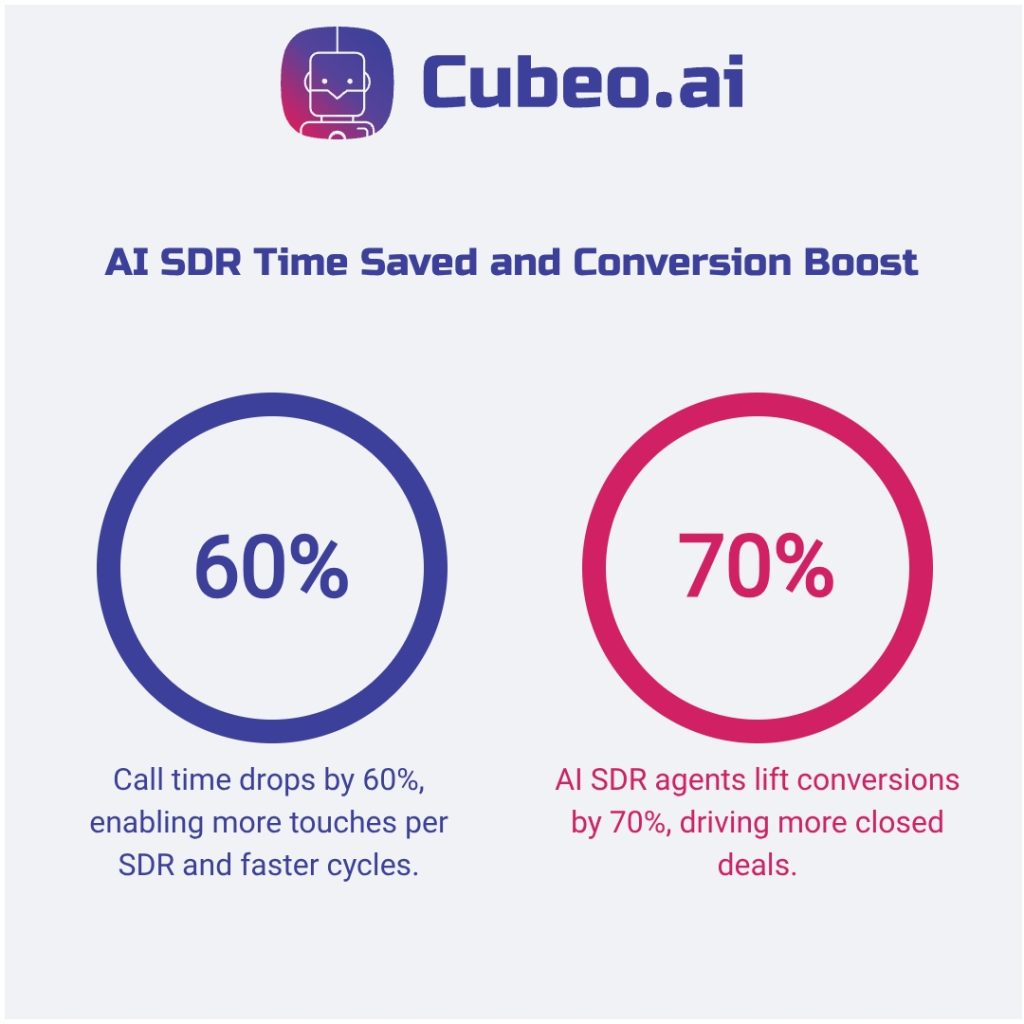
Think of AI agents like skilled assistants preparing everything for approval rather than hitting send for you. SuperAGI found AI-driven ops can raise lead volume ~50%. Call time drops ~60%, enabling more touches per SDR and faster qualification cycles. Industry analyses also show AI SDR agents lift conversions up to 70% and cut operational sales costs 40–60%. One limitation matters: AI cannot build genuine relationships or navigate complex negotiations—require human handoff, approved messaging, and guardrails for high-risk conversations.
What Human SDRs Bring to the Table
Human strengths remain essential in 2026:
- Emotional intelligence and relationship building during high-stakes conversations
- Complex objection handling requiring improvisation and nuance
- Strategic account planning with multi-threading across stakeholders
- Trust-building in consultative sales where deal cycles extend beyond 90 days
Automate scale. Keep humans where persuasion determines outcomes.
The Objective Comparison: Costs and Performance
Real ROI comes from reclaiming SDR time and redirecting it to higher-leverage work like strategic outreach and account planning. Numbers tell the story.
TCO Breakdown for AI and Human SDRs
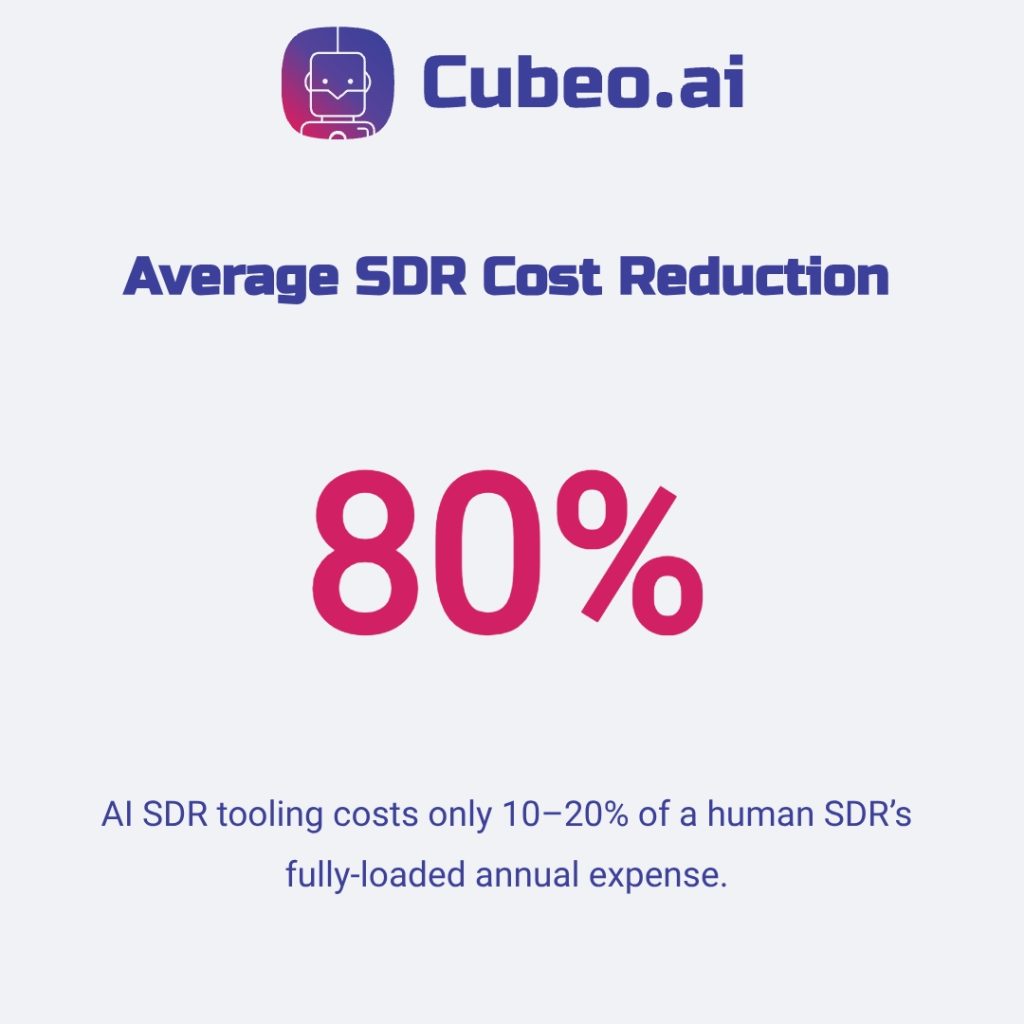
Rule of thumb: AI tooling typically costs 10-20% of a fully-loaded human SDR for transactional plays. Human SDRs cost $75,000-$125,000 annually including salary, benefits, training, management overhead, and tech stack. AI platforms run $500-$5,000 monthly for subscription, plus $5,000-$50,000 one-time implementation and 10-20% annual maintenance.
Productivity and Quality Metrics
AI SDRs handle 1,000+ contacts daily versus 50-100 for humans, operating 24/7 with instant response times. Salesforce found 83% of sales teams using AI saw revenue growth versus 66% without AI.
When Each Approach Wins
Choose AI for high-volume inbound, 24/7 follow-up coverage, data-heavy qualification, and repeatable sequences. Choose humans for enterprise deals over $50K, complex products requiring technical explanation, relationship-driven sales, and strategic account planning involving multiple stakeholders.
Hybrid typically wins: AI preps, humans close.
The Hybrid Approach: Getting the Best of Both
Quick action: Pilot Dossier plus Drafting for 2–4 weeks, measure hours reclaimed and meetings booked. Automation wins when humans stay in the loop and outcomes are instrumented from day one. Sales teams overwhelmingly choose hybrid: 77% blend AI efficiency with human judgment rather than picking one exclusively.
Why Hybrid Models Win
AI owns top-of-funnel work—prioritization, research, initial outreach, and qualification. Humans take over for relationship building, complex conversations, discovery calls, and closing. Think of it as swim lanes: AI agents (Prioritizer, Dossier, Drafter, Follow-up) prep everything so SDRs enter conversations with context and momentum already built.
Hybrid implementations deliver measurable gains:
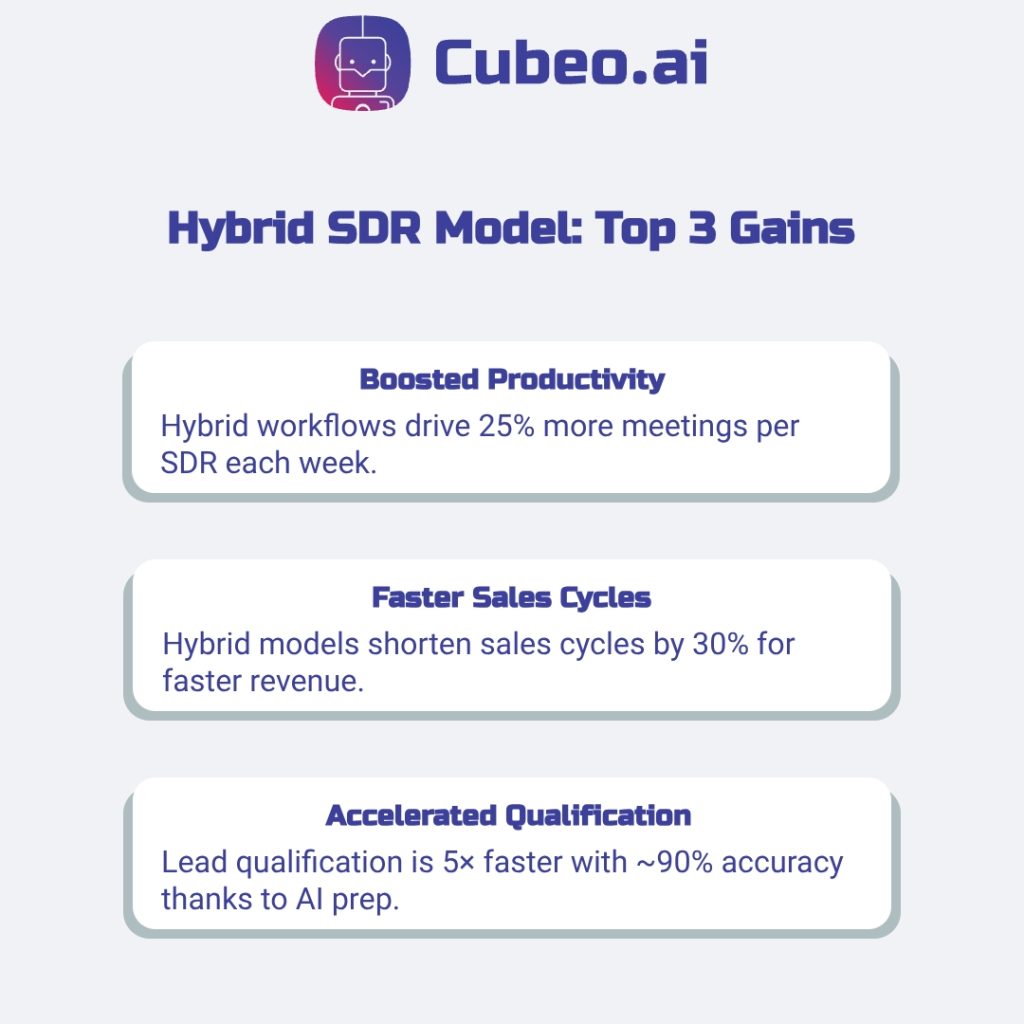
- 25% higher sales productivity — more meetings per SDR per week
- 30% shorter sales cycles — faster deal velocity and improved forecast accuracy
- 5x faster lead qualification with ~90% accuracy — reduces research time and speeds handoffs
Implementing a Hybrid Workflow
Start small. Pick one workflow—Dossier plus Drafting—before expanding. Maintain draft first, approve-before-send from day one; never run fully autonomous initially.
Set explicit handoff triggers:
- Lead score ≥ 65 and contact verified → SDR conducts discovery
- Firmographic match plus intent signal → human phone outreach
- ACV > $50K or multi-stakeholder account → immediate human review
Making Your Decision: A Framework for Sales Leaders
Your decision hinges on four variables: company size, deal complexity, sales cycle length, and budget. Quick if-then decision tree:
- If <50 employees or cycle <30 days → Pilot AI for ops automation
- If >500 employees or ACV >$50K → Pilot hybrid with clear swim lanes
- If mid-complexity deals → Split ops to AI, relationships to humans
Decision Criteria Checklist
Identify your SDR bottlenecks first—time sinks like research and data entry, efficiency killers like inconsistent follow-ups, and outcome pains like missed meetings. Then apply these rules:
Company size:
Small (<50 employees) → Lean toward AI for scale without headcount
Large (500+ employees) → Use hybrid to balance coverage and relationship depth
Deal complexity:
Transactional → AI handles volume efficiently
Consultative → Humans lead with AI support
Mid-complexity → Hybrid splits tasks by stage
Sales cycle length:
<30 days → AI automates fast-moving qualification and follow-up
>90 days → Human-led with AI handling research and scheduling
Budget constraints:
Limited → Start with AI to reclaim SDR hours at lower cost
Flexible → Invest in hybrid for maximum leverage
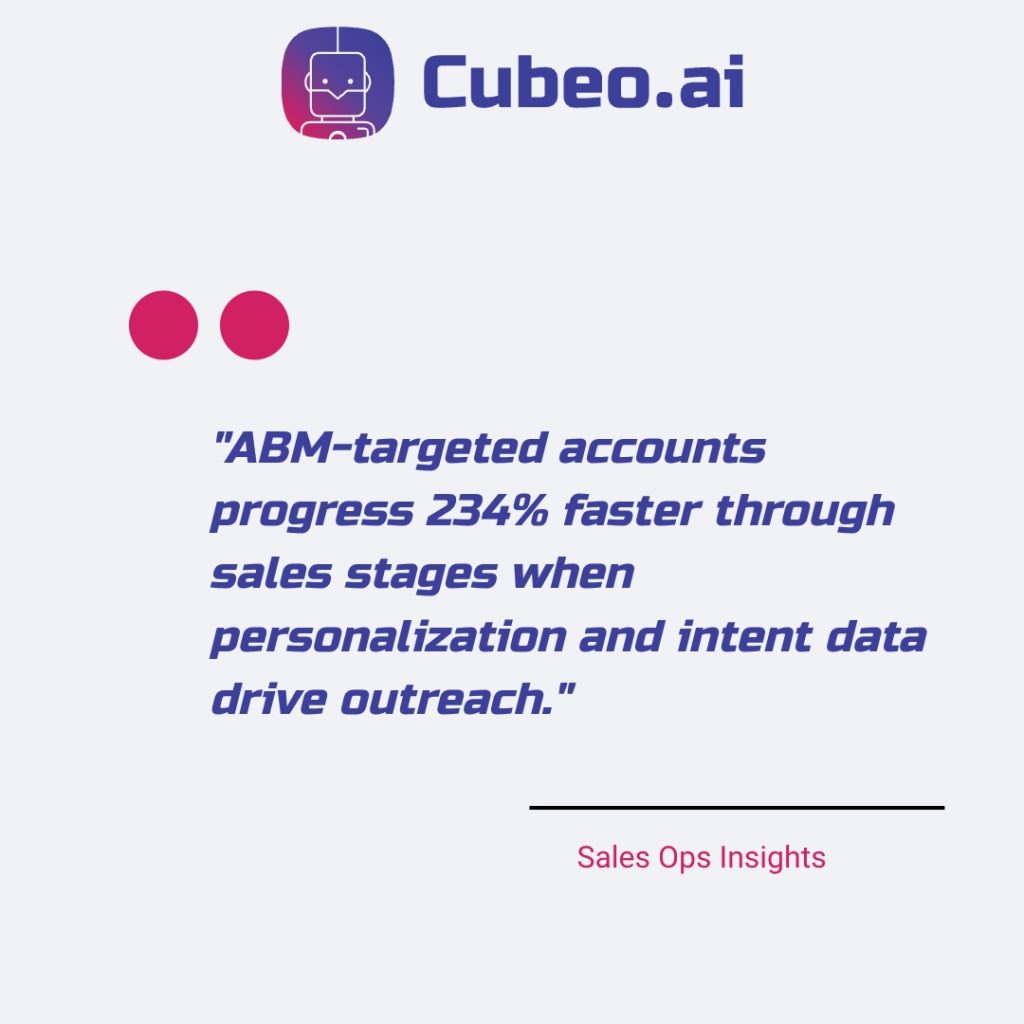
ABM-targeted accounts progress 234% faster through sales stages when personalization and intent data drive outreach.
Build vs Buy Considerations
Buy off-shelf if: Simple use case, need speed to market, limited technical resources, or standard transactional flow.
Build custom if: Unique customer profile (ICP) needs, complex multi-stage workflows, specific compliance requirements, or you want full control over agent decision rules—what actions trigger and when.
Getting Started: Your Next Steps
Pilot one workflow and expect measurable hours reclaimed in 2–4 weeks. Industry case studies show up to 7x conversion lifts, 40–60% ops cost reductions, and ~5-month payback periods.
If AI: Week 0–1 configure Dossier or Drafter; Week 1 require draft-first human approval for all outbound; Week 2 measure hours saved and meetings booked.
If hybrid: Week 0 map handoff rules; Week 1 deploy AI for research plus drafts; Week 2 reps run discovery calls and track conversion lift.
FAQ
What is an AI SDR and how does it differ from a human SDR?
An AI SDR is an Artificial Intelligence Sales Development Representative that automates prospecting, outreach, and lead qualification, often using natural language processing to understand customer intent. It works tirelessly, handling repetitive tasks like identifying leads, sending personalized messages at scale, and scheduling meetings, freeing up human bandwidth.
Unlike human SDRs, who excel at building deep relationships, navigating complex conversations, and adapting to nuanced social cues, AI SDRs are designed for consistent, high-volume execution. An AI SDR can process vast amounts of data and respond to inquiries in under a minute, optimizing the top of the sales funnel with speed and accuracy. While humans bring empathy and strategic judgment to complex sales cycles, AI SDRs ensure that initial touchpoints are always on, always consistent, and always logging critical data into your CRM. This automation ensures a reliable, scalable foundation for pipeline generation.
Practically, if you’re looking to eliminate manual data entry, streamline initial outreach, and ensure rapid follow-ups, an AI SDR provides the reliable automation needed. It focuses on the repeatable, predictable parts of the sales process, allowing your human team to engage where their unique strengths—like building trust and closing deals—truly matter.
How much does an AI SDR cost compared to hiring a human SDR?
Deploying an AI SDR offers a significant cost advantage, typically costing around $500 per month, which is about 83% less than the fully loaded expense of a human SDR. A human SDR, encompassing salary, commissions, benefits, and the necessary tech stack, can cost an organization approximately $6,000 per month, or between $98,500 to $180,000 annually.
This dramatic cost reduction with AI SDRs allows businesses to allocate resources more efficiently, translating to substantial savings in operational expenditure. Beyond the direct monthly subscription, AI SDRs eliminate the ongoing costs associated with hiring, training, and high attrition rates common in human SDR roles. This isn’t just about a cheaper tool; it’s about a fundamental shift in sales economics, where the cost per qualified lead can drop by as much as 85%, from $262 for human SDRs to a mere $39 for AI systems.
For teams focused on production-ready outcomes, this means building a scalable, high performing sales development engine without the prohibitive overhead. An AI SDR delivers a predictable, lower-cost model that directly impacts the bottom line, freeing up budget for other strategic initiatives or enabling you to scale your outreach far beyond what a traditional human team could achieve.
What is a hybrid SDR model and why do most teams choose it?
A hybrid SDR model thoughtfully combines AI-powered sales tools with skilled human SDRs, blending the precision and speed of automation with the critical empathy and strategic thinking of people. In this model, AI handles the heavy lifting of data segmentation, lead enrichment, identifying patterns, and generating initial outreach drafts. Human SDRs then step in to refine these messages, manage complex objections, and engage in real, nuanced conversations that build trust and rapport.
Most teams choose this model because it delivers superior results by leveraging the best of both worlds. AI drives unparalleled efficiency and scalability, processing vast amounts of data and operating 24/7 to ensure consistent, high-volume outreach. This frees human SDRs to focus on high-value activities that demand emotional intelligence, creative problem solving, and relationship-building—the areas where humans truly excel. This strategic collaboration leads to significantly higher ROI, improved lead scoring, real-time adaptation to market shifts, and more personalized outreach at scale, all while maintaining cost efficiency without compromising the human touch that ultimately converts leads into loyal customers. It’s about building a robust, production-ready pipeline that capitalizes on both technological and human strengths.
Should I build custom AI SDR workflows or buy an off-the-shelf tool?
The decision to build custom AI SDR workflows versus buying an off-the-shelf tool hinges on whether the AI solution represents a commodity or a core competitive advantage for your business. If your primary need is for generalized tasks like basic chatbots, standard CRM automation, or routine document analysis—functions that many companies perform similarly —an off-the-shelf tool offers speed of deployment and lower upfront costs. These solutions provide quick wins and leverage proven infrastructure.
However, if your business operations involve unique workflows, proprietary data, strict compliance requirements, or if the AI is central to a distinctive customer experience or business model, then building custom AI SDR workflows is a strategic imperative. Custom solutions are purpose-built to integrate seamlessly with your existing systems, optimize for your specific challenges, and unlock unique revenue streams that generic approaches cannot. While custom builds require more significant investment in time and resources, including dedicated talent for development and maintenance, they deliver long-term ROI and defensibility that generic tools simply can’t match. Always start by clearly defining your business problem and expected outcomes to determine if a commodity solution will suffice, or if your goals demand a custom, production-ready system that truly differentiates your operations.