
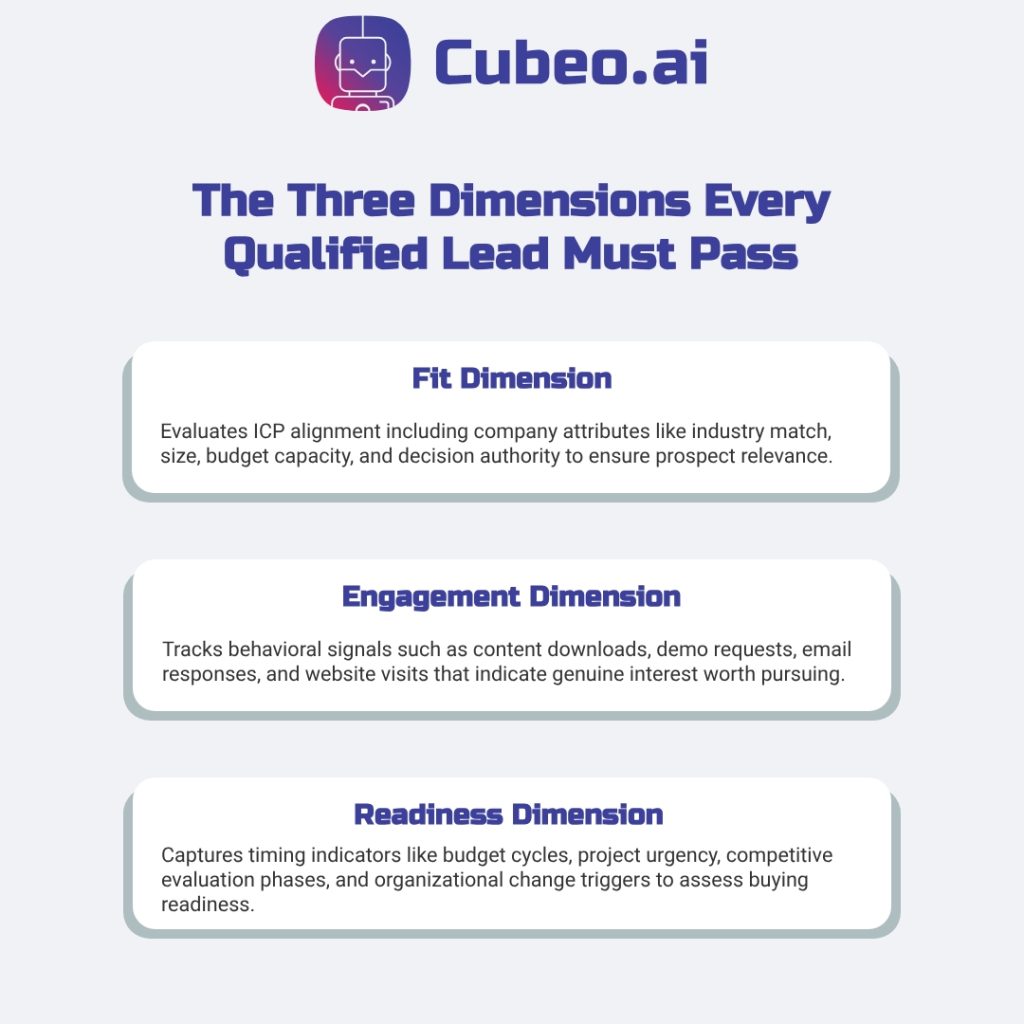
Lead qualification is a repeatable decision system that tells your reps whether a prospect is worth seller time. It checks 3 things: fit (does this company match your ICP?), engagement (are they showing buying behavior?), and readiness (is timing right?).
Each dimension acts as a filter that protects your team from wasted outreach.
Lead scoring ranks who to call first. Qualification decides whether a rep should spend time on a prospect at all. Scoring helps prioritize pipeline. Qualification conserves seller time and forecast accuracy by removing bad-fit accounts early.
What Lead Qualification Really Means and Why Sales Teams Fail Without It
Sales teams fail when qualification systems break. Research shows 67% of lost sales result from inadequate lead qualification, yet only 25% of marketing-generated leads actually qualify for sales engagement. Reps burn hours researching prospects who will never buy. Qualification depends on upstream research quality — your ICP (ideal customer profile) definition, pain points, and buying signals must be accurate before you evaluate fit.
Picture this: Marketing delivers 200 inbound leads. Sales reviews the list and finds only 20 match target criteria. Without qualification, reps waste weeks chasing 180 bad-fit prospects. With qualification, those 20 high-value accounts get immediate attention while others move to nurture or disqualification queues.
The 3 Dimensions Every Qualified Lead Must Pass
Fit dimension evaluates ICP alignment: company attributes like industry match, size, budget capacity, and decision authority. A SaaS vendor selling to enterprises shouldn’t waste time on 10-person startups, no matter how engaged they appear.
Engagement dimension tracks behavioral signals: content downloads, demo requests, email responses, website visits. Silent prospects rarely convert. Active engagement indicates genuine interest worth pursuing.
Readiness dimension captures timing indicators: budget cycles, project urgency, competitive evaluation phases, organizational change triggers. A prospect with approved budget next quarter qualifies differently than one still building internal business cases.
Speed matters: responding within one hour increases qualification odds seven times compared to slower follow-up. Event teams achieve scan-to-CRM times under 10 seconds, proving fast qualification is operationally feasible and protects pipeline quality.
7 Lead Qualification Frameworks and How to Choose One
Choosing a qualification framework feels overwhelming when 7 options exist. Each framework serves different sales motions, deal complexities, and buying processes. Your job: pick one that matches your team’s reality, then adapt it.
Here’s how the 7 major frameworks compare:
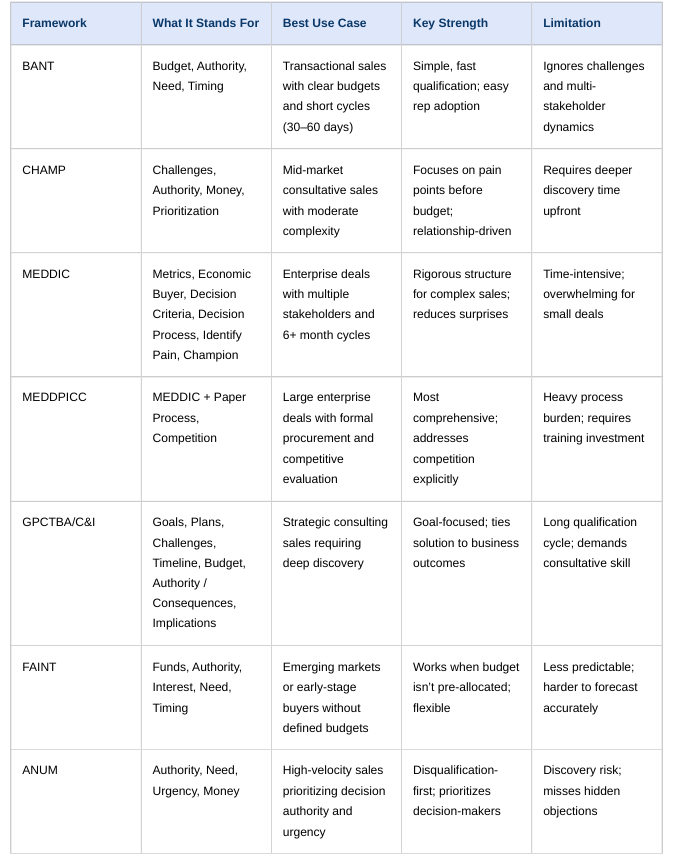
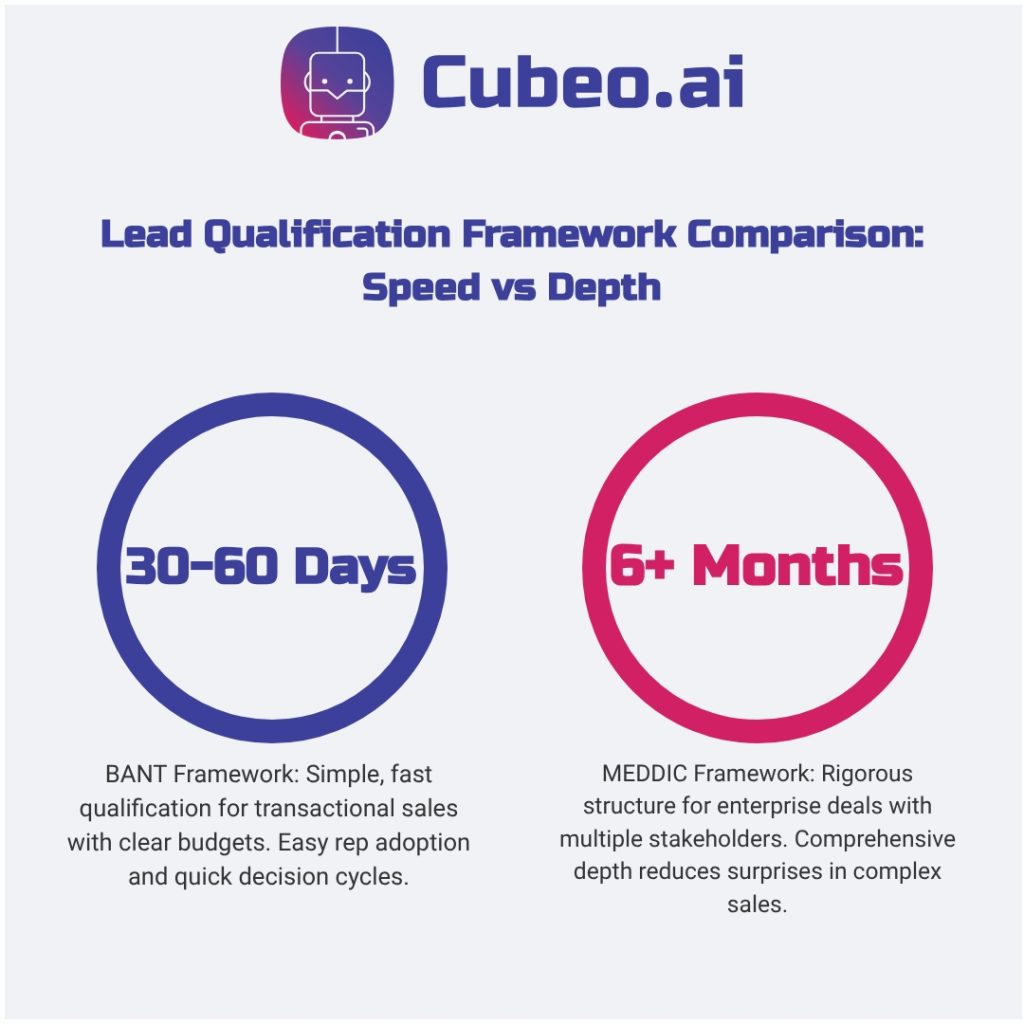
Frameworks vary significantly in complexity, with BANT excelling in speed while MEDDIC provides depth for enterprise complexity. No single framework fits every sales motion. Teams often combine elements from multiple approaches to match their specific buying process.
Decision Logic for Choosing Your Framework
Use this decision flow to map your sales motion to the right framework:
Cycle <60 days, transactional: BANT works for high-volume sales where budget clarity exists upfront
Mid-market consultative: CHAMP suits sales where understanding challenges drives value articulation
Enterprise $100K+, 6+ months: MEDDIC or MEDDPICC handles multiple stakeholders and formal decision processes
Strategic consulting: GPCTBA/C&I ties solutions to business goals and outcomes
No-budget/early-stage: FAINT assumes budget flexibility in emerging markets
High-velocity inside sales: ANUM prioritizes urgency and decision authority above depth
Operational rule for readiness: Require a readiness check for every lead. Track “time-to disqualify” — target under 48 hours for inbound transactional leads, under 7 days for enterprise initial disqualifications. Fast negative decisions free seller time for qualified prospects.
Common hybrid pattern: BANT→MEDDIC. Use BANT for quick inbound triage (Budget, Authority, Need, Timing). If estimated deal size exceeds $25K, escalate to MEDDIC checks for Champion identification and Decision Criteria validation. This two-stage approach balances speed and thoroughness without overwhelming reps on small deals.
Test your chosen framework for 30 days, measure MQL→SQL conversion and time-to disqualify, then iterate based on conversion data.
Essential Qualification Questions by Framework
Each framework demands specific discovery questions aligned with fit, engagement, and readiness dimensions:
BANT:
- “What budget have you allocated for this initiative?” (fit: budget capacity)
- “Who makes the final decision?” (fit: decision authority)
- “What happens if you don’t solve this problem?” (engagement: pain severity)
- “When do you need this in place?” (readiness: timing)
CHAMP:
- “What’s the biggest obstacle preventing you from achieving X?” (engagement: challenge identification)
- “Who else needs to approve this?” (fit: authority mapping)
- “How is this funded?” (fit: money availability)
MEDDIC:
- “What metrics will you use to measure success?” (engagement: metrics-driven evaluation)
- “Who controls budget?” (fit: economic buyer)
- “How do you typically evaluate vendors?” (readiness: decision process)
- “Who internally champions this project?” (engagement: champion presence)
Build a question bank aligned with your chosen framework, training reps to probe fit, engagement, and readiness systematically for consistent qualification outcomes.
The Lead Qualification Process in 7 Production-Ready Steps
Repeatable qualification runs on a systematic workflow that moves leads from capture to decision without manual bottlenecks. Implement these seven steps within 30 days to build a production-ready qualification system.
- Step 1: Define ICP and Qualification Criteria
Translate your fit, engagement, and readiness model (covered earlier) into specific CRM fields and scoring rules. Document firmographic thresholds, behavioral triggers, and readiness indicators as numeric values your automation can act on.
- Step 2: Capture Leads from Generation Sources
Aggregate inbound leads from forms, events, partnerships, and outbound prospecting into your CRM. Standardize field names across sources so enrichment and scoring work consistently regardless of origin.
- Step 3: Enrich Lead Data
Automate lookups so reps stop spending hours on basic research. AI-powered enrichment cuts manual research from 2 hours to 2-3 minutes per prospect.
What to append: company revenue, employee count, technology stack, buying signals, contact details.
How to do it: enrichment APIs, batch jobs for older leads, triggered enrichment on new records.
- Step 4: Score Leads Against Criteria
Turn criteria into numeric rules. Calculate fit score (ICP alignment), engagement score (behavioral activity), and readiness indicators (timing signals).
Scoring template example: +40 points for industry match, +30 for company size in range, +20 for demo request, +10 for pricing page visit. MQL threshold = 80 points.
Companies implementing systematic AI scoring see 40% improvements in accuracy, enabling better prioritization and resource allocation.
- Step 5: Route Qualified Leads to Sales
Push scored leads through MQL → SAL → SQL progression with validation checkpoints at each stage. This Qualify stage fits between discovery and engagement in your systematic prospecting workflow, ensuring reps receive only validated opportunities.
- Step 6: Sales Discovery and Validation
Sales reps conduct discovery calls to confirm qualification through direct conversation — this human validation layer (i.e., a short call or manual review) confirms automated scores. Reps validate fit assumptions, probe pain severity, confirm budget and authority, and assess solution match.
- Step 7: Accept, Disqualify, or Recycle
Based on discovery findings, reps accept qualified leads as opportunities, disqualify poor-fit prospects, or recycle early-stage contacts to nurture sequences. Teams implementing structured qualification achieve 20% higher conversion rates while reducing sales cycle length.
How to Structure Marketing-to-Sales Qualification Handoff
MQL (Marketing Qualified Lead): engagement threshold met, ICP fit confirmed, ready for sales review. Marketing passes leads with enriched context and scoring rationale.
SAL (Sales Accepted Lead): sales reps review MQLs and accept or reject based on additional context unavailable to automated systems. Reps apply judgment that automation cannot replicate.
SQL (Sales Qualified Lead): discovery completed, qualification confirmed through conversation, opportunity created in pipeline. This represents handoff from qualification to active deal pursuit.
Handoff guardrails prevent qualification breakdown:
- Document shared definitions across teams
- Implement validation checkpoints at each transition
- Create feedback loops where sales reports why leads fail qualification so marketing adjusts targeting
Common failure mode: misaligned definitions between marketing and sales create rejection cycles. Fix this through joint criteria development sessions where both teams agree on thresholds upfront.
Why Disqualification Is a Core Qualification Skill
Fast disqualification saves more resources than slow qualification wastes. Clear disqualification criteria: ICP mismatch, missing budget or authority, wrong timing, solution misfit.
Early disqualification protects rep time (hours saved per week), sales cycle length (fewer stalled deals), and forecast accuracy (cleaner pipeline predictions).
Recommended SLA: track time-to-disqualify and target under 48 hours for inbound transactional leads, under 7 days for enterprise initial disqualifications. Document your disqualification process: clear criteria, documentation of reasons for pattern analysis, recycle paths that move disqualified leads to nurture or archive based on gap severity.
Cultural shift required: treat disqualification as success (protecting team resources), not sales failure. Many teams observe early disqualification rates between 40-60% depending on funnel quality and industry. That’s healthy pipeline hygiene.
AI-Powered Lead Qualification That Sees Context Not Just Data
AI qualification systems analyze patterns invisible to manual review at scale. While reps evaluate dozens of leads weekly, AI examines thousands of operational signals to identify context that database filters miss.
Traditional filtering asks “Does this company match our size and industry criteria?” Contextual AI qualification asks deeper questions about operational reality and solution fit.
Key operational signals AI evaluates (examples beyond demographics):
- Product-model fit: Do they ship physical goods? Run subscription services?
- Hiring patterns: Are they adding roles that indicate upcoming projects?
- Technology stack: Does their martech setup complement or conflict with your solution?
- Content engagement sequence: Which pages did they visit first, then what followed?
These operational signals—real-world indicators of buying context—reveal intent demographics cannot show. The Ixaria case demonstrated this approach: their team used AI to evaluate product type and marketing stack compatibility beyond standard firmographics, achieving a 50% reply rate because AI identified prospects whose operational reality matched solution fit.
AI assists; humans decide. AI-powered lead scoring achieves over 90% accuracy in identifying high-conversion leads, with top-scoring leads converting 3.5x better than average. Yet automation requires guardrails: human validation at handoff points, review thresholds for edge cases, and feedback loops where reps flag scoring errors so models improve.
The 3-stage AI qualification workflow operates as Discover → Qualify → Engage. AI agents —automated reasoning routines that pull and interpret multiple data signals—find ICP matches through operational signal analysis (Discover), score and route leads through automated qualification rules (Qualify), then trigger personalized outreach based on contextual insights (Engage). Each stage includes validation checkpoints where humans review AI decisions before progression.
Teams report large time savings and higher-quality leads when AI handles enrichment and early scoring.
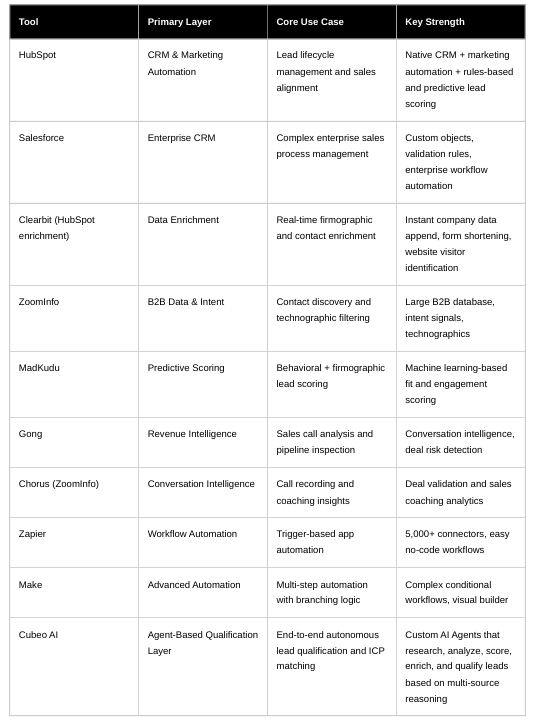
12 Lead Qualification Tools and When to Use Each
Here’s how qualification tools map to your workflow stages:
Lead Qualification Metrics and How to Optimize Over Time
Qualification quality determines forecast accuracy and pipeline predictability. Measure these 10 KPIs to validate your qualification system delivers revenue outcomes, not just activity metrics.
1. Qualification Accuracy
Why it matters: Higher accuracy means fewer false opportunities and cleaner forecasts.
Measure: (SQLs converted to opportunities ÷ total SQLs) × 100. Target: 40–60%.
2. MQL → SQL Conversion Rate
Why it matters: Shows alignment between marketing targeting and sales acceptance criteria.
Measure: (MQLs accepted as SQLs ÷ total MQLs) × 100. Target: 20–30%. Teams implementing structured scoring see significant improvements.
3. Sales Cycle Impact
Why it matters: Early disqualification saves weeks per deal by preventing unqualified prospects from clogging pipeline.
Measure: Compare average deal length for qualified vs disqualified leads. Track days from capture to final decision.
4. Forecast Reliability
Why it matters: Cleaner qualification reduces forecast error and improves predictability.
Measure: Quarterly forecast error rates (forecast vs actual) before and after qualification changes.
5. Resource Efficiency
Why it matters: Reps spend time on prospects who will close instead of researching dead ends.
Measure: Sales hours saved per qualified lead vs unqualified. Time wasted on unqualified prospects drops from 35% to 10% with systematic qualification.
6. Qualification Velocity
Why it matters: Faster decisions mean quicker engagement with hot prospects before interest cools.
Measure: Days from lead capture to qualification decision. Target: under 48 hours for transactional, under 7 days for enterprise.
7. Disqualification Rate
Why it matters: High early rejection protects resources and signals healthy pipeline hygiene.
Measure: Early rejection percentage. Commonly reported range: 40–60% depending on funnel quality and lead sources.
8. Framework Effectiveness
Why it matters: Shows which qualification approach yields best conversion for your sales motion.
Measure: Conversion rates by framework type (BANT vs MEDDIC vs hybrid). Track SQL→opportunity conversion by framework.
9. Team Alignment
Why it matters: Shared definitions prevent rejection cycles between marketing and sales.
Measure: Survey sales, marketing, ops quarterly on criteria clarity. Target: 80%+ agreement.
10. Iteration Frequency
Why it matters: Regular updates keep qualification aligned with market changes and buyer behavior shifts.
Measure: Quarterly reviews completed and criteria adjustments implemented. Track threshold changes and conversion impact.
FAQ
What is lead qualification and why does it matter for sales teams?
Lead qualification is the systematic process of evaluating potential customers to determine if they are a good fit for your product or service and, crucially, if they are likely to make a purchase. It’s about separating the serious buyers from those just browsing.
This process matters immensely for sales teams because it ensures they allocate their valuable time and resources to the prospects with the highest conversion potential. By focusing on qualified leads, sales reps can improve their efficiency, shorten sales cycles, and make revenue forecasting far more reliable. Without effective qualification, teams risk wasting effort on individuals who lack the budget, authority, or genuine need for the solution, leading to pipeline inefficiencies and missed targets. It’s a production-ready approach to sales, ensuring every interaction moves a business metric.
Implementing a robust lead qualification process allows sales teams to engage with prospects who genuinely align with the solution and are ready to move forward. This strategic focus not only boosts win rates but also optimizes the entire sales pipeline, ensuring that effort translates directly into measurable business outcomes. It’s about building workflows that survive real-world edge cases, where time is a critical constraint.
What are the best lead qualification frameworks for B2B sales?
The best lead qualification frameworks for B2B sales are BANT (Budget, Authority, Need, Timeline), MEDDIC (Metrics, Economic Buyer, Decision Criteria, Decision Process, Implicate the Pain, Champion), and CHAMP (Challenges, Authority, Money, Prioritization).
These frameworks provide a structured, operator-grade methodology for evaluating prospects, helping sales teams determine if a lead is a good fit and ready to buy. The choice of framework often depends on the complexity of the deal and the length of the sales cycle. BANT is excellent for high-volume, shorter sales cycles, offering a fast, repeatable screening process. MEDDIC is tailored for complex enterprise deals with multiple stakeholders, requiring a deep understanding of the customer’s business and decision-making process. CHAMP, which prioritizes customer challenges, is ideal for consultative sales where understanding the core problem is paramount. Many modern teams combine elements, using BANT for initial screening and then MEDDIC or CHAMP for deeper discovery.
Effective qualification isn’t a one-time gate; it’s a continuous process. Layering frameworks across different sales stages and integrating intent signals helps to not only assess fit but also gauge timing, ensuring that sales efforts are always directed towards the most promising opportunities that move business metrics. This approach builds reliable, repeatable processes for production-ready AI automation.
How does AI improve lead qualification accuracy beyond demographics?
AI improves lead qualification accuracy by analyzing behavioral signals, engagement patterns, and historical conversion data, moving beyond basic demographics to predict a lead’s true potential and intent with production-ready precision.
Traditional lead scoring, often reliant on static demographic data, frequently misses critical indicators of buying readiness. AI, powered by machine learning, processes vast amounts of dynamic data to uncover subtle patterns and correlations that human reviewers might overlook. It’s about building systems that handle complexity. AI algorithms analyze various data points, including website visits, content engagement, email interactions, and even sentiment from communications, to construct comprehensive prospect profiles. This enables predictive lead scoring that continuously learns from outcomes, refining its accuracy over time. For instance, AI can identify specific sequences of behavior—like pricing page visits followed by case study downloads—that strongly predict conversion, allowing sales teams to prioritize leads based on actual purchase interest rather than just general fit.
This multi-dimensional analysis not only boosts accuracy but also accelerates the qualification process through rapid data processing and automated lead routing. By focusing on these deeper, data-driven insights, AI ensures that sales teams engage with leads who are genuinely in-market, leading to higher conversion rates and more efficient resource allocation, ultimately moving business metrics.
What metrics should you track to measure qualification effectiveness?
To measure lead qualification effectiveness, key metrics include the MQL to SQL conversion rate, lead quality score, and customer acquisition cost (CAC). Tracking these provides an operator-grade view of your process.
These metrics offer a clear, data-driven picture of how well your qualification process is performing, allowing you to assess the efficiency of your sales team and the quality of leads generated by marketing. The MQL to SQL Conversion Rate is critical, showing the percentage of marketing-qualified leads that sales accepts as truly qualified, indicating strong alignment between marketing and sales efforts. A Lead Quality Score helps prioritize leads by assigning a value based on their likelihood to convert, enabling more effective resource allocation and ensuring focus on high-potential opportunities. The Customer Acquisition Cost (CAC) measures the average expense to acquire a new customer, helping to ensure that lead generation and qualification efforts are sustainable and profitable, anchoring claims to outcomes.
Regularly reviewing these metrics helps identify gaps in your processes, refine your lead scoring models, and optimize your overall sales strategy. By continuously monitoring and adjusting based on data, businesses can ensure they are consistently focusing on the most
promising opportunities and maximizing their return on investment, building reliable, repeatable systems for measurable impact.