
Scaling social content without sounding robotic is possible when you automate the right tasks and preserve brand voice through structured workflows. Decision rule: automate repeatable work; keep humans for judgment calls. Your roadmap follows four stages: decide what to automate, encode voice rules, test with approval gates, and monitor metrics.
Social Media Content Automation That Preserves Your Brand Voice
You don’t need to sacrifice authenticity to scale. Strategic social media content automation targets scheduling, repurposing, and draft generation. Human oversight handles engagement responses, crisis communications, and posts requiring personal touches. This separation allows you to triple output without sounding robotic.
What to Automate and What to Keep Human
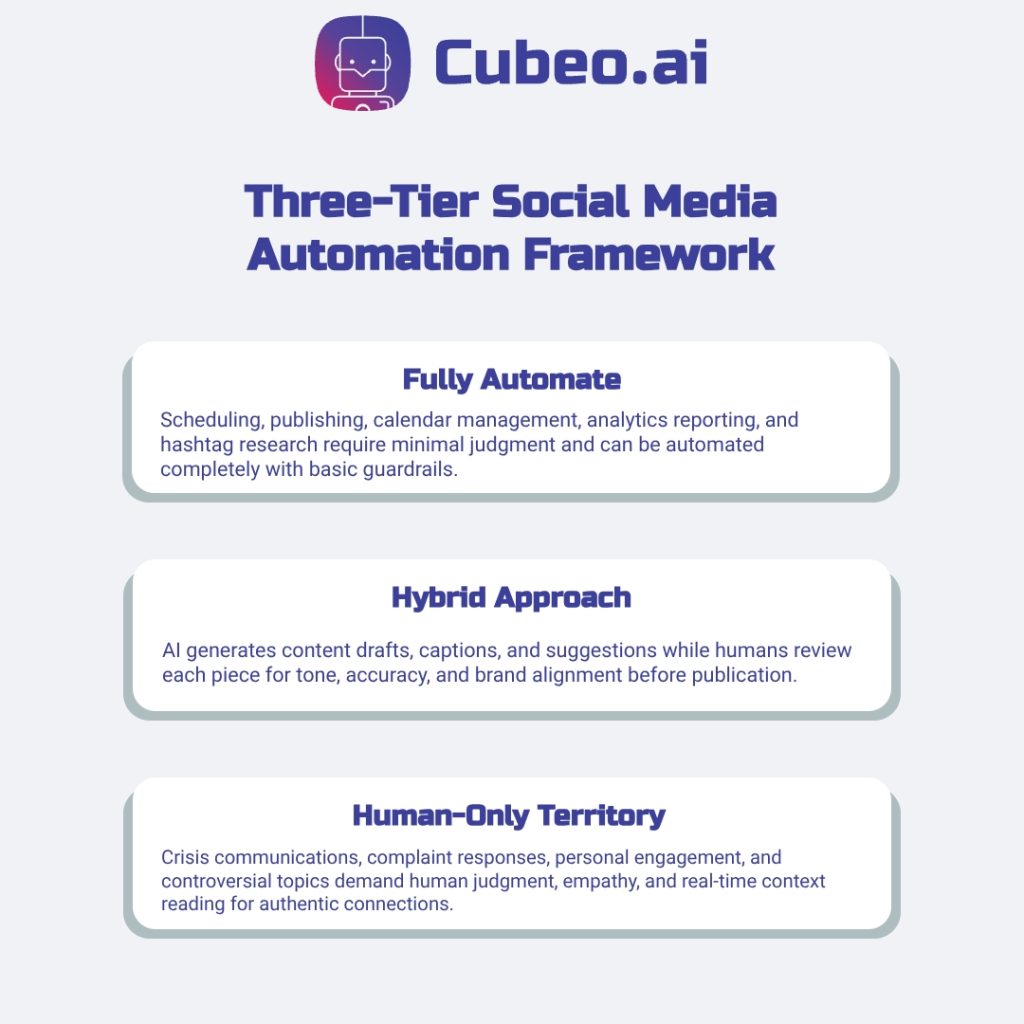
Manual social posting creates bottlenecks. Recent automation efficiency research shows 63% of marketers report manual work limits business results. Quick decision checklist: Daily tasks with low judgment risk get automated; judgment-heavy work goes hybrid with approval gates; high-stakes empathy moments stay human-only.
Tier 1: Fully Automate Safe Tasks
Repetitive operational work belongs here. Automate these tasks completely:
- Scheduling and publishing across platforms
- Content calendar management
- Cross-platform posting with format adaptation
- Analytics reporting and performance tracking
- Hashtag research and suggestion generation
These activities require minimal judgment. Systems handle them reliably when you add basic guardrails: format validation checks, failed-post retry logic, and audit logs. Monitor error rate and missed posts weekly. Start your automated social media posting workflow here.
Tier 2: Hybrid Automation—AI Generates, Human Approves
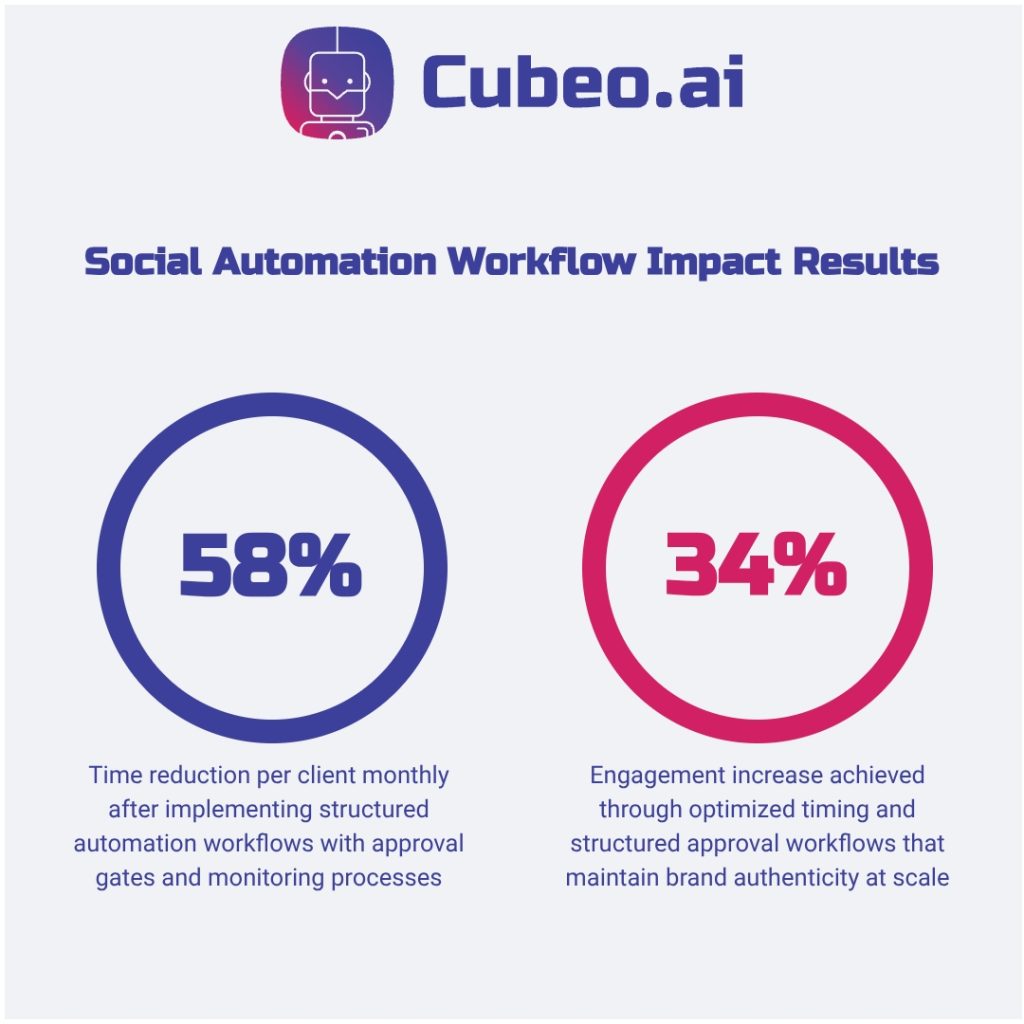
Hybrid models scale content production while preserving voice accuracy. Verde Wellness implemented an AI content automation framework for their supplement brand. AI generated daily posts, and humans reviewed each piece. Results: 15 hours saved weekly, engagement rate jumped from 1.8% to 4.2%, and conversion rates increased 3x.
This tier includes content drafting with mandatory review, caption generation following brand guidelines, hashtag suggestions based on performance data, image selection from approved libraries, and repurposing blog content into social snippets. Set a 24-hour SLA for default reviews and 4-hour SLA for time-sensitive promotional posts. Use a simple review checklist: tone check, CTA validation, factual accuracy, compliance scan. Review should take 1–3 minutes per post with structured approval fields.
Tier 3: Never Automate—Human-Only Territory
Some tasks demand human judgment and empathy. Industry research warns that automation backfires in crisis situations and recommends keeping sensitive responses human-controlled.
Never automate responses to complaints or criticism requiring empathy, community conversations needing personal touches, crisis communications during sensitive events, personal brand engagement with individual followers, or controversial topics requiring nuanced judgment. Documented cases show brands faced backlash when automated responses during service failures amplified customer anger instead of resolving issues.
Authentic engagement requires reading context and adjusting tone in real time. Your audience detects scripted responses immediately. Keep human judgment in conversations where empathy, context, and reputational risk determine outcomes. Content automation works for drafts; engagement automation fails for relationships.
A Framework to Preserve Your Brand Voice in Automation
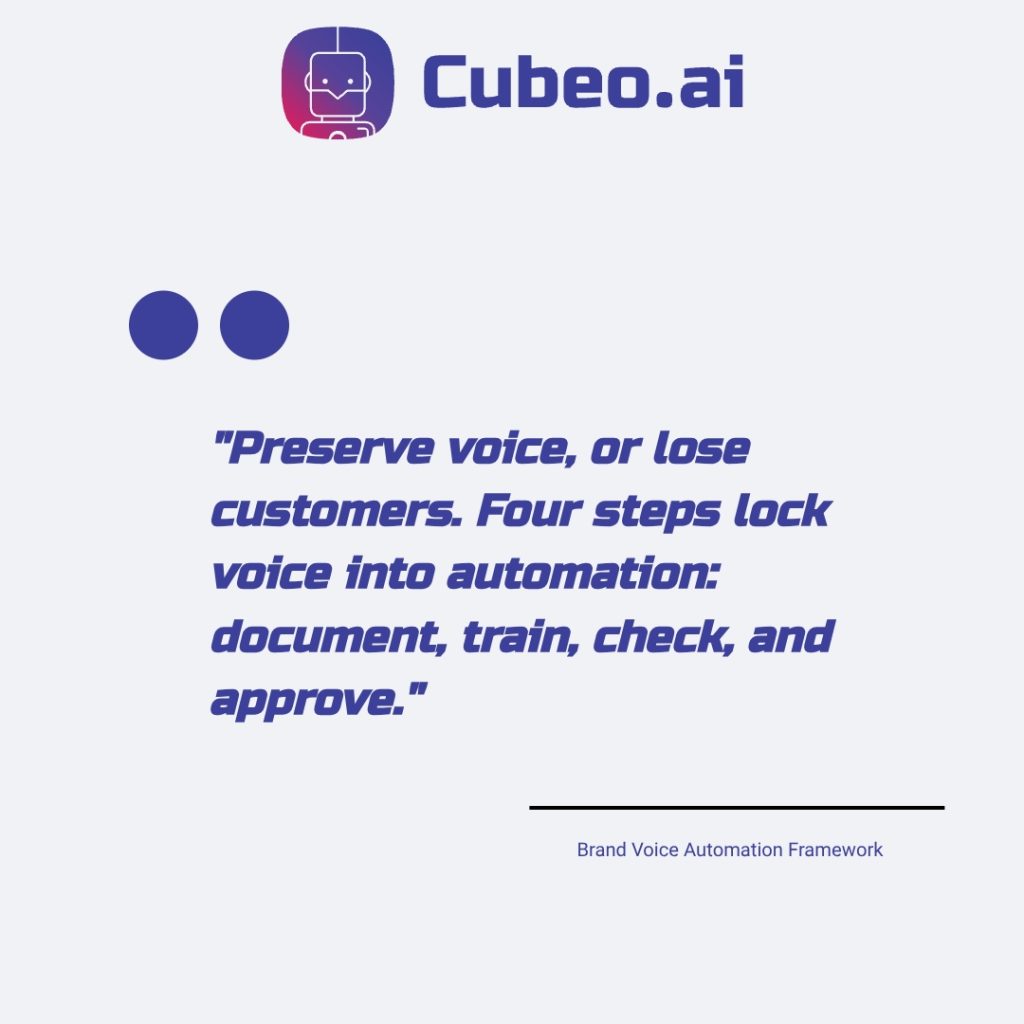
Preserve voice, or lose customers. Social media data analysis shows how massive, active audiences across platforms make consistent brand messaging essential. Four steps lock voice into automation: document tone and vocabulary, train AI with curated examples, use a fast authenticity checklist, and add approval gates.
Document Your Brand Voice—The Foundation
Run a two-hour workshop once and reference it forever:
- Tone window: Mark three anchors (formal, neutral, playful)
- Must-use and banned words: Ten each minimum
- Core topics and off-limits topics: List both
Your documentation becomes training data for AI agents and quality benchmarks for reviewers. Capture emotional range appropriate for your audience and articulate core values guiding content decisions.
Train Your AI Agent with Examples
Upload 10–15 best-performing posts as training data. Set specific instructions like “always use empowering language” and “avoid corporate jargon.” Test outputs against original brand examples before deploying to production.
Cubeo AI workflows let you attach brand examples directly to content generation steps. Your AI agent references those examples every time it drafts captions or suggests posts, maintaining consistency at scale.
The Authenticity Checklist—Quality Control
Use this scannable checklist for every automated post (under two minutes per review):
- Does this sound like our brand voice?
- Is tone appropriate for this platform?
- Does it include human touches like questions, emotion, or personality?
- Does it have engagement potential worth commenting on?
- Are there generic AI-sounding phrases to remove?
Watch for red flags: phrases like “as an AI” or overly formal language that signals robotic drafting. Train your team to apply these five checks with structured review fields. Voice accuracy improves when you enforce consistent quality gates.
Platform Tactics: Instagram, LinkedIn, and Twitter
Don’t use one-size-fits-all automation. You’ll get better reach by matching format and tone to each platform.
Instagram: Visual-First Automation with Personality
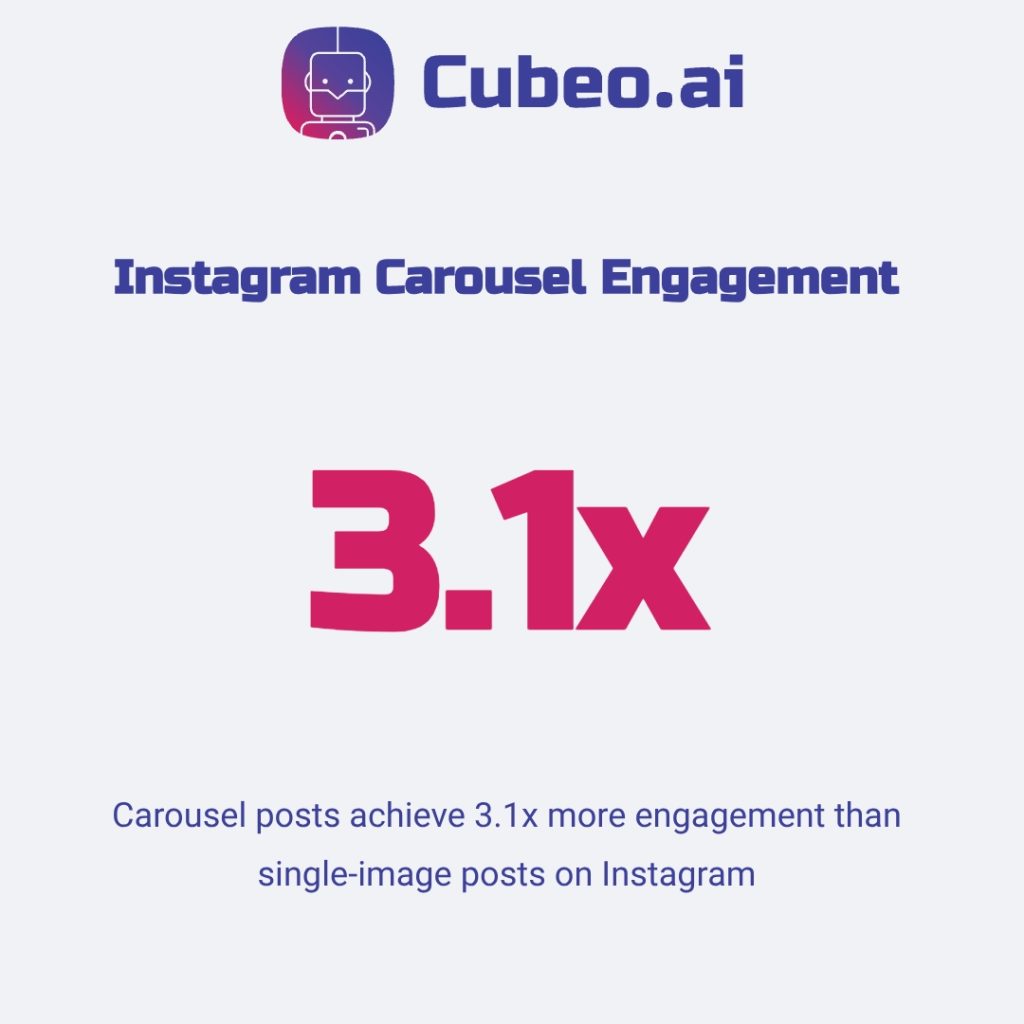
Do this: automate carousel assembly from templates; humans add the final caption tweak to keep voice intact. Algorithm analysis shows carousel posts achieve 1.4x higher reach and 3.1x more engagement than single-image posts. Instagram prioritizes save rates, so educational carousels with consistent brand colors perform best.
Schedule stories with authentic captions avoiding generic CTAs like “swipe up” or “link in bio.” AI handles caption drafting, but preserve personality with emojis, casual tone, and questions inviting responses. Maintain visual consistency through preset filters and brand color palettes.
Comment responses belong in Tier 3 (human-only territory). Automated replies sound robotic and damage trust.
LinkedIn: Professional Automation Without Sounding Corporate
Do this: automate article scheduling for consistent thought leadership; always add a personal hook before publishing. Best practice playbooks recommend 3–5 posts weekly for professional content that balances polish with personal insights.
Use AI for initial drafting, then add specific examples from your experience. Generic LinkedIn posts (“Excited to share…”) get ignored. Automate connection follow-ups, but personalize opening messages with context about why you’re connecting.
Responses to comments on personal brand posts stay human (see Tier 3). Those conversations build relationships driving business outcomes.
Twitter: Real-Time Engagement with Scheduled Consistency
Do this: automate thread scheduling for multi-tweet narratives; reserve capacity for live reactions to industry news. Platform scheduling strategies suggest 2–5 posts daily with varied formats: standalone tweets, threads, and quote tweets.
Use AI for drafting but maintain conversational tone with contractions, casual language, and direct responses. Automate monitoring of brand mentions, yet manually engage in actual conversations. Twitter users detect automated responses immediately during trending topics requiring context.
Reserve 10–20% of your posting capacity for spontaneous engagement. Automation playbooks recommend keeping slots open for reactive content that shows your brand follows real conversations. Never automate responses to trending topics; context shifts too quickly for pre-programmed replies.
Set Up an Authentic Social Automation Workflow in 4 Steps
Implementation separates successful automation from wasted effort. Workflow automation research shows marketing teams save an average of 6 hours weekly through structured processes. 4 steps take you from audit to live workflow with authenticity intact.
Step 1: Audit Your Current Social Media Workflow
Mission: Identify which tasks consume time without requiring judgment calls.
- Track time spent on each social task for one week (drafting, scheduling, formatting, cross-posting, responding, reporting)
- Categorize activities using the Tier 1/2/3 framework from earlier: fully automate, hybrid, or human-only
- Document bottlenecks where work stalls or requires excessive manual effort
- List repetitive activities that repeat daily or weekly
Step 2: Design Your Automation Workflows
Mission: Map your content flow and insert approval gates at judgment points.
- Map the full creation flow: idea → draft → review → schedule → publish → monitor
- Mark automation points where AI drafts content and humans review for brand consistency
- Build workflows with approval gates at Tier 2 decision points using workflow templates (includes role assignments and schema examples)
- Configure output format as predictable fields: caption, tone tag, CTA, hashtags, image suggestion
Plain-language schema example: AI generates structured output (caption text / professional tone / shop now CTA / 5 hashtags / product image). Structured formats speed human review because approvers know exactly what to check.
Step 3: Set Up Your AI Agent with Brand Guidelines
Mission: Train your agent using documented voice rules and test outputs before going live.
- Upload the brand voice documentation from the framework section (tone spectrum, vocabulary, topics, values)
- Configure specific instructions: vocabulary to use, phrases to avoid, emotional range
- Run 10–15 sample posts through the workflow as tests
- Review each sample against your five-question authenticity checklist
- Adjust instructions until outputs consistently match your brand voice
Test loop: generate samples → review → adjust settings → regenerate. Repeat until quality passes consistently.
Step 4: Establish Approval and Monitoring Processes
Mission: Set roles, notifications, and regular audits to catch drift before it reaches audiences.
- Designate approval roles for different content types (promotional, educational, engagement)
- Configure notification workflows when automated content is ready for review
- Set review SLAs: 24 hours for default posts, 4 hours for time-sensitive content
- Schedule weekly audits of automated content performance and brand consistency
- Collect audience feedback on whether content sounds authentic
A scalable automation platform shows how modern systems handle scheduling, approval notifications, and secure media management reliably.
Micro-ROI calculation: 6 hours saved weekly × $50 hourly rate = $300 weekly value; $1,200 monthly minus $200 tool cost = $1,000 net monthly savings. Iterate based on engagement data and consistency feedback monthly.
Measure Automation ROI and Authenticity
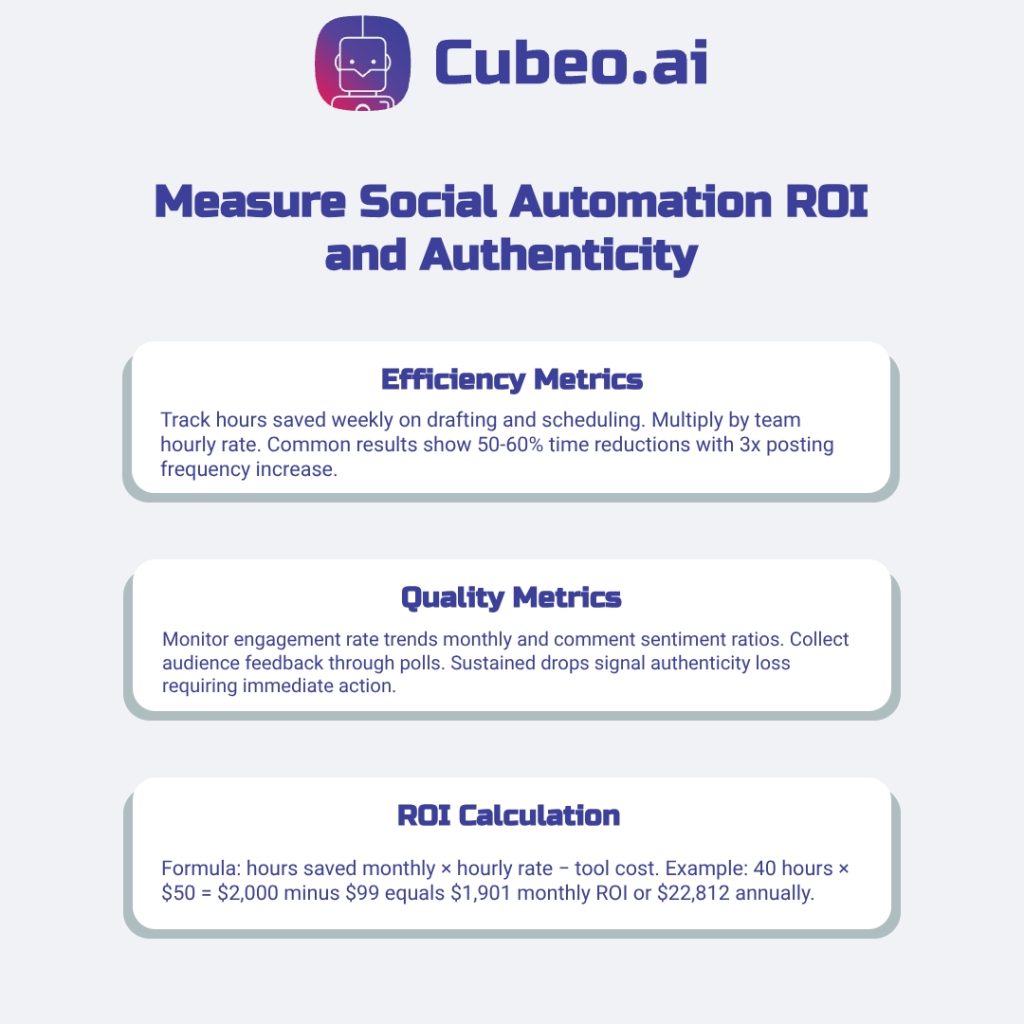
Quick test: hours saved × hourly rate − tool cost = monthly ROI. Run this on one platform for 30 days to prove social automation without losing voice. Measure two categories: efficiency and quality.
Efficiency Metrics Prove Time Savings
Hours saved: Track hours weekly on drafting, formatting, scheduling; multiply by team hourly rate for weekly value
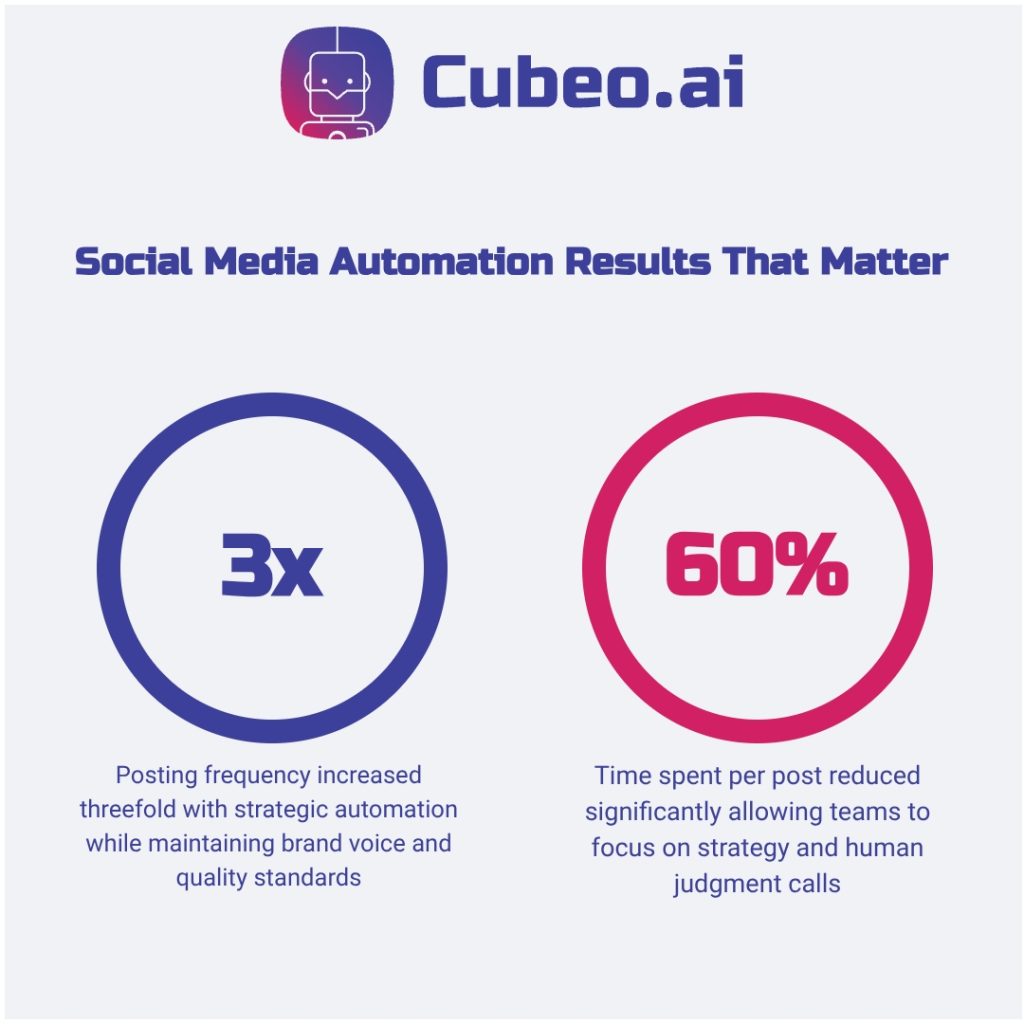
- Consistency lift: Compare posts/week before versus after automation; internal projects commonly show 50–60% time reductions with 3x posting frequency increase
- Reclaimed capacity: Assign recovered hours to community building, campaign testing, and analytics—tangible business gains
Document reduction in manual cross-posting time across platforms. Calculate weekly time saved and multiply by team size to see total capacity recovered for strategic work.
Quality Metrics Ensure Authenticity Maintained
Monitor engagement rate trends monthly. Declining rates signal authenticity loss. Social media ROI research shows 65% of marketing leaders want direct links between campaigns and business goals, with 90% of shoppers influenced by authentic user-generated content. Track comment sentiment ratios: positive versus negative responses. Collect audience feedback through polls asking whether content sounds like your brand. Conduct manual monthly audits scoring brand voice consistency.
Calculate Your Automation ROI
Formula: hours saved monthly × team hourly rate − automation tool cost = monthly ROI.
Concrete example: 40 hours saved monthly × $50 hourly rate = $2,000 value minus $99 tool subscription equals $1,901 monthly ROI, or $22,812 annually. Multiply monthly ROI by 12 for annual impact. Include setup costs, media spend, and training as one-time or amortized expenses.
FAQ
How do I know which social media tasks are safe to automate?
Identifying safe social media tasks for automation centers on repetitive, low-engagement activities that consume time without requiring nuanced human judgment. These typically include scheduling posts, publishing content across multiple platforms, monitoring brand mentions, and generating performance reports.
Automation excels where predictability and consistency are key. Utilizing platforms designed to streamline these workflows frees up your team from manual, administrative burdens. This allows for a strategic shift, redirecting human effort towards creative content development, deeper community engagement, and analytical insights that genuinely drive business metrics. It’s about leveraging technology to manage the mechanics so human expertise can focus on high-impact activities. Always consult your security team when integrating new automation tools, especially when connecting corporate accounts, to ensure compliance and mitigate potential risks.
The true return on investment from automation isn’t just the time saved, but the ability to reallocate those resources to initiatives that build stronger connections and deliver measurable business outcomes, such as crafting compelling narratives or engaging directly in conversations.
Will my audience notice if I'm using automation for social media?
Your audience can indeed notice if automation leads to impersonal, generic, or poorly timed content that lacks a human touch and fails to engage authentically. While AI-powered automation enhances efficiency and offers data-driven insights for better content, over reliance without strategic human oversight risks stripping away the authenticity that builds trust.
Content that feels robotic, out of context, or simply recycled across platforms without proper adaptation can erode audience trust and reduce genuine connection. The challenge is not the automation itself, but the “set it and forget it” mindset, which can lead to missed opportunities for meaningful interaction. To maintain audience trust and avoid detection, use automation for its strengths—scheduling, cross-platform adaptation, and analytics—but always integrate a human review layer. Customize automated responses, adapt content for each platform’s unique voice, and actively monitor sentiment to jump into conversations directly when needed. Automation should enhance human interaction, not replace it.
Effective social media engagement thrives on building relationships, and while automation manages the mechanics, the strategic and emotional intelligence for impactful communication remains a human responsibility.
How much time can social media automation actually save?
Social media automation can reclaim significant hours each week by streamlining repetitive, time-consuming tasks like content scheduling, cross-platform publishing, and performance reporting, allowing your team to focus on strategic initiatives and genuine engagement. Tools such as Zapier, Hootsuite, and Buffer are specifically designed to eliminate the manual grind of daily social media management.
By automating the batch creation, scheduling, and distribution of content across various platforms, businesses can drastically reduce operational overhead. This isn’t merely about saving minutes on individual tasks, but about freeing entire blocks of time that would otherwise be spent on administrative work. The time saved can then be strategically invested in higher-value activities like creative content development, community building, direct audience engagement, and deeper strategic planning informed by performance data. This shift allows for a more proactive and impactful social media presence, driving both efficiency and measurable business outcomes rather than just managing logistics.
The most impactful result of automation isn’t just the hours saved, but the ability to elevate your social media strategy from reactive to proactive, leading to improved audience insights and better-performing content.