
Most teams generate plenty of leads. The problem is qualification quality—deals stall because reps chase wrong prospects and burn weeks on leads that never close.
Research shows 67% of lost sales trace back to inadequate qualification. Teams waste 72% of prospecting time on manual research that reveals basic fit signals too late.
You’re an SDR or AE chasing quota. You need lead qualification questions that separate real opportunities from time sinks—fast.
This playbook delivers 50 non-redundant sales qualification questions organized by framework (BANT, CHAMP, MEDDIC) and buyer stage. This includes disqualification triggers most guides skip and a short AI pre-research workflow.
Why Lead Qualification Breaks Down
Reps ask random questions without strategic purpose. That wastes hours and leaves pipelines full of dead deals.
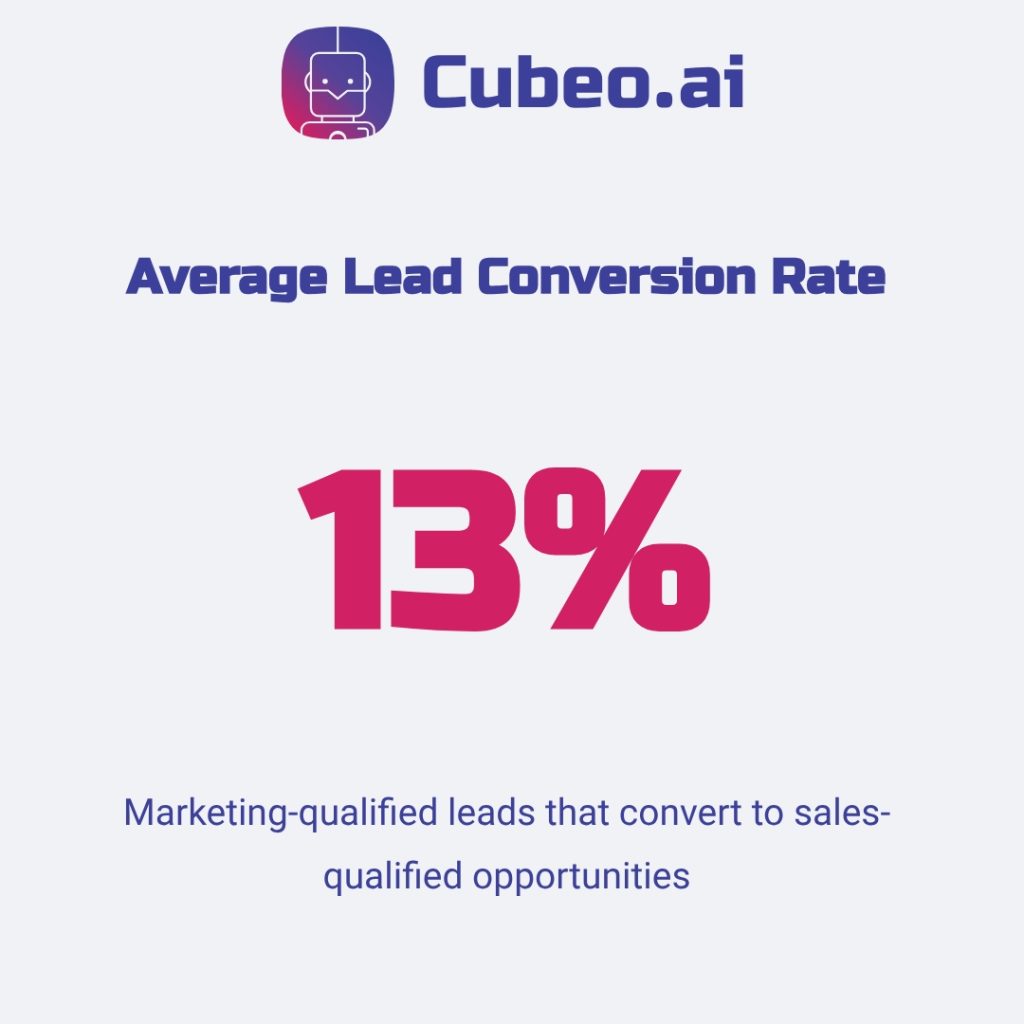
Only 13% of marketing-qualified leads convert to sales-qualified opportunities on average. Most teams chase all of them anyway. Manual research takes 2-3 hours per prospect; AI based workflows cut that to minutes.
Ixaria found the same gap. Databases show company size and industry but miss contextual facts like “does this company sell physical products?” That nuance requires reasoning, not database fields. Human research filled the gap until AI reasoning automated contextual evaluation.
Qualification is Stage 2 of the prospecting pipeline (Discover → Qualify → Engage). Without structured frameworks, reps burn time on leads that never convert.
Broken qualification creates a specific failure pattern. Pipelines look full. Deals stall in late stages. AEs chase forecasts that never close. The fix starts with choosing a framework that matches your sales motion.
Pick the Right Qualification Framework
BANT-qualified opportunities close 33% more often than unstructured approaches. Pick the right framework and close more deals.
Framework choice controls which lead qualification questions matter. Asking good questions with the wrong framework wastes discovery time and produces inconsistent pipeline quality.
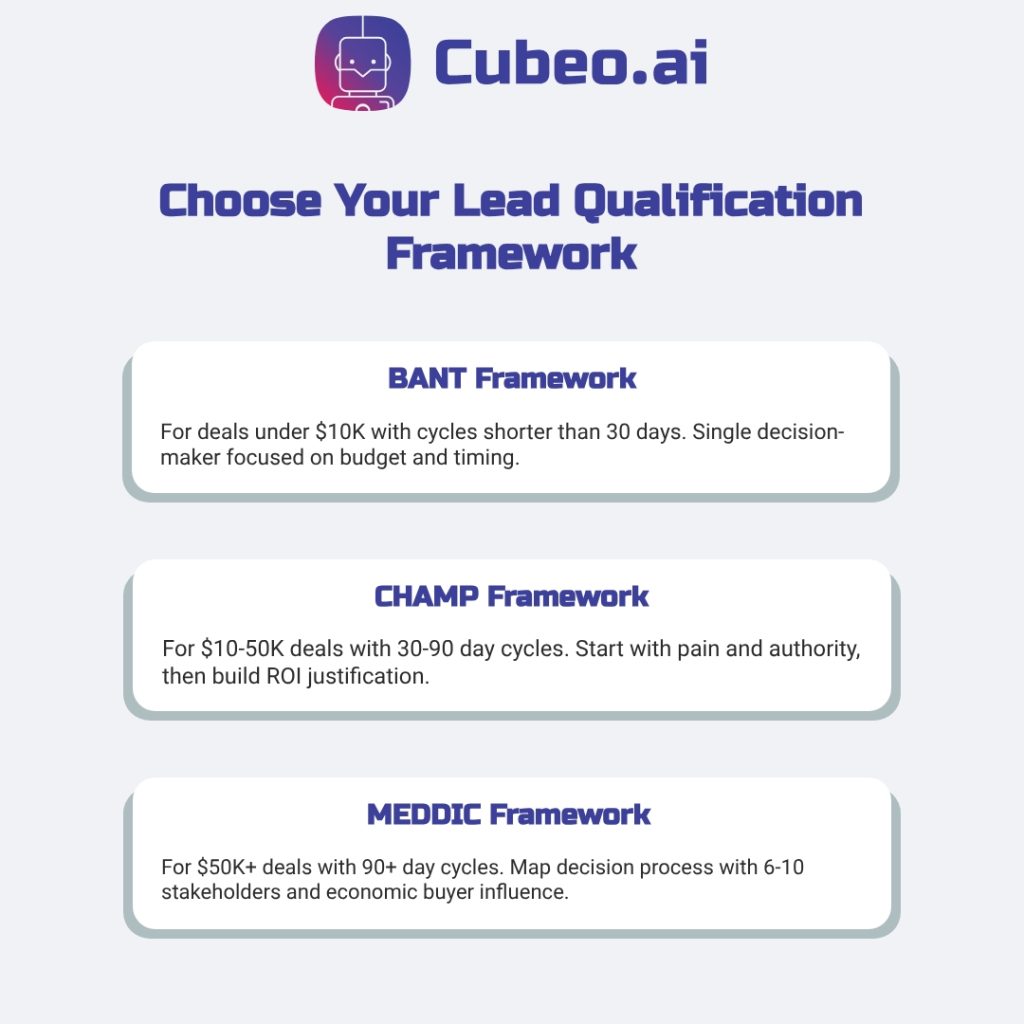
3 frameworks cover most B2B sales motions. BANT handles transactional deals under $10K. CHAMP fits consultative mid-market sales where you build ROI cases. MEDDIC manages enterprise complexity with committee decisions. Structured question formatting enables AI tools to parse answers and pre-score fit signals.
Quick decision rule:
- Deal <$10K AND cycle <30 days → BANT
- Deal $10-50K AND cycle 30-90 days → CHAMP
- Deal >$50K AND cycle >90 days → MEDDIC
When to Use Each Framework
BANT: Deals under $10K, cycles shorter than 30 days, single decision-maker. Budget and timing drive conversations.
CHAMP: $10-50K deals, 30-90 day cycles. Start with pain and authority, then build ROI justification.
MEDDIC: $50K+ deals, 90+ day cycles, 6-10 stakeholders. Map decision process, economic buyer influence, technical criteria early.
Use the framework that matches your deal size and cycle—then pick the 6-8 live questions below.
50 Essential Questions for Lead Qualification
Reference this during live discovery calls. Questions organized by core qualification criteria —fit, authority, disqualification—for quick scanning and accurate qualification.
Research shows 82% of B2B decision-makers think reps arrive unprepared to first meetings. Clear heading hierarchy and numbered lists make questions scannable during calls and enable AI tools to parse answers for pre-scoring. Log answers as structured CRM fields (numeric where possible) to feed AI scoring.
Each question appears once. Pick 6-8 based on your framework and buyer stage.
Company Fit and Need Questions (1-15)
1. Trigger — why now?
2. Current process — tools & steps?
3. Failure point — what breaks?
4. Time lost (hrs/week)?
5. What have you tried?
6. Who else feels this pain?
7. Success in 90 days — what does it look like?
8. Cost of inaction by [timeline]?
9. Impact on quarterly goals?
10. Competing priorities?
11. Company size (employees/locations/customers)?
12. Industry regulations affecting decision?
13. Revenue model (subscription/transactional/service)?
14. Growth stage (growing/restructuring/maintaining)?
15. Market position vs competitors?
Authority and Decision Process Questions (16-35)
Discovery questions reduced stalled deals by 30% by mapping economic buyers and approval paths early.
16. Who reviews proposals?
17. Where does pushback come from?
18. Evaluation criteria?
19. Who gives final approval?
20. Does procurement negotiate separately?
21. Who controls budget?
22. Comparing other vendors?
23. Decision timeline?
24. Last similar purchase — who led?
25. Map everyone involved?
26. Typical approval workflow?
27. Who champions projects?
28. Which executives care most?
29. Committee role splits?
30. Preferred vendor list?
31. References required?
32. Legal review required?
33. Who evaluates technical fit?
34. Who owns implementation?
35. How many sign-offs needed?
Disqualification Questions (36-50)
Early disqualification protects pipeline quality. Ask these to identify exits before investing weeks in dead deals.
36. Locked into competitor contract?
37. Hiring freeze or budget lock?
38. Implementation resources available?
39. Already decided on vendor?
40. Conflicting initiative priority?
41. Policy restrictions on new vendors?
42. Will you advocate if stalled?
43. Deal-breakers?
44. Team ready for change?
45. 30% higher price = disqualified?
46. Timeline conflicts?
47. Full-time owner assigned?
48. Urgency (1-10)?
49. Budget approved or pending?
50. Authority to proceed?
Use AI pre-research to pre-fill factual answers (size, tech stack, contract status) and surface high-confidence leads for live questioning—details in the next section.
AI Workflows That Do Pre-Qualification
SDRs spend hours manually researching company websites, hiring pages, and tech stacks to answer basic qualification questions. AI agents automate that research before discovery calls start.
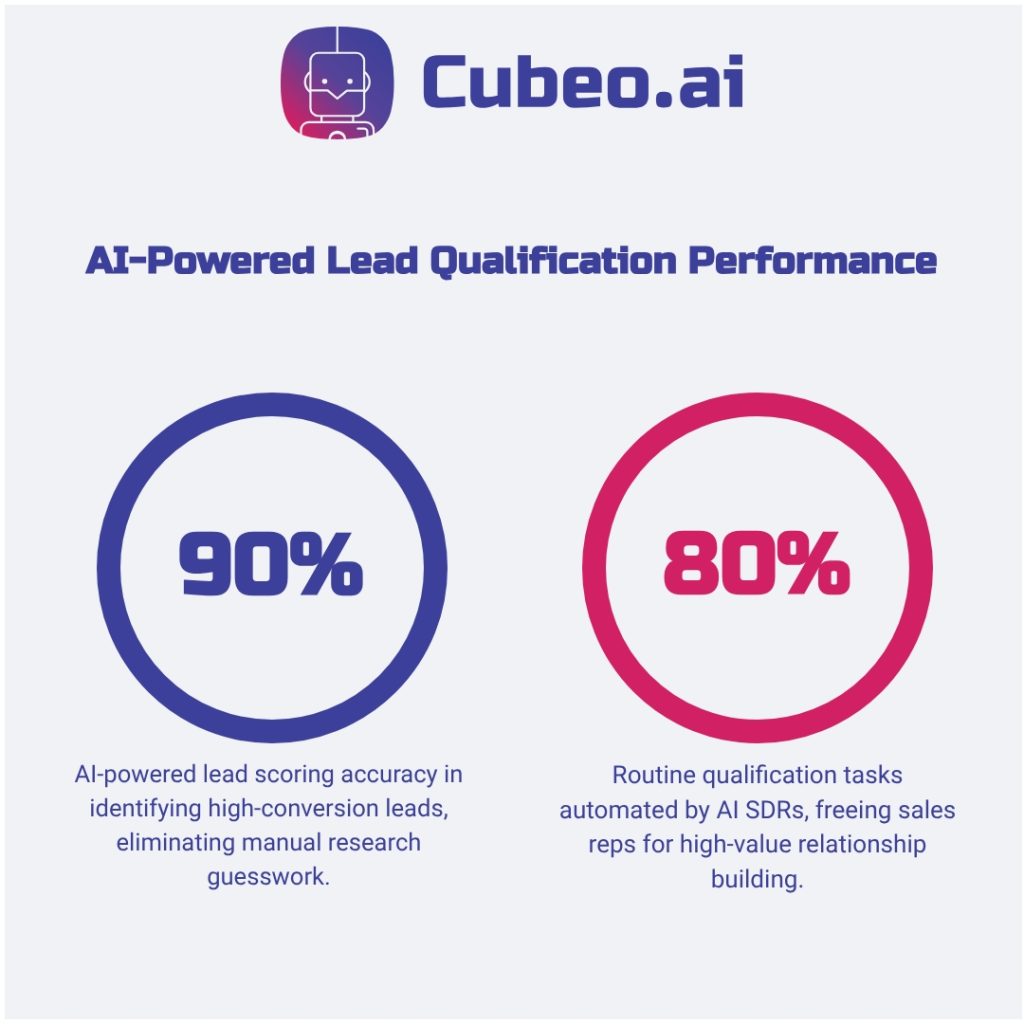
Follow a trigger-based pattern: trigger (lead enters with ICP match), fetch (site copy, tech stack, hiring patterns, funding), apply (pre-fill answers and score confidence), log (CRM fields plus audit trail). AI-powered lead scoring delivers over 90% accuracy in identifying high-conversion leads.
Case studies show up to 215% more qualified leads and 30% shorter sales cycles. Discovery calls shrink from 30 minutes to 15 when factual questions are pre-answered.
Customize AI prompts to your ICP parameters. Set a confidence threshold: scores ≥80% can pre-fill CRM fields and skip factual checks on calls; <80% queue for human review. For MEDDIC or enterprise deals, route all pre-fills through an AE or sales engineer regardless of score.
Put These Questions Into Practice
Over 80% of generated leads fail to convert due to poor qualification. Fix that with a four step workflow: choose your framework based on deal size, select 6-8 questions per call from relevant sections above, deploy AI for pre-research, focus human time on pain and authority.
Deploy specialized AI agents to pre-research fit and timing questions—research agent fetches facts, scoring agent assigns confidence scores, validation agent flags low-confidence items for human review.
Budget and ROI questions:
- Is budget allocated? If yes, how much?
- ROI expectations defined?
- Current spend on similar tools?
- Price range that triggers internal approval workflows?
- Success metrics tied to investment?
Timing and urgency questions:
- Implementation timeline target?
- What’s driving that timeline?
- Priority level (1-10)?
- Hard deadlines forcing decision?
- Consequences if delayed?
Log answers as structured CRM fields (question ID, answer, confidence). Tag calls and measure demo conversion by question ID over 30 days. Early disqualification protects pipeline quality. Modern qualification frameworks produce 67% higher conversion rates when applied consistently.
FAQ
What are the most important lead qualification questions to ask?
The most important lead qualification questions are those that quickly assess a prospect’s genuine need, budget, authority to purchase, and urgency, ensuring your team focuses on opportunities that can actually close. These questions cut through the noise to identify if a solution fit exists and if the timing is right for a real business impact.
Effective qualification starts by understanding the core problem a prospect is trying to solve and why they are seeking a solution now. This includes probing into their current situation, what they’ve tried before, and the specific outcomes they expect. Beyond the problem, it’s critical to uncover their budget allocation, who holds the decision-making power, and their timeline for implementation. Without these clear signals, you risk investing valuable sales cycles into leads that won’t convert, impacting your team’s overall efficiency and measurable results.
By asking targeted questions about their pain points, desired results, available resources, and internal decision process, you can quickly determine if a lead aligns with your Ideal Customer Profile. This allows sales teams to prioritize high-intent leads, tailor their approach, and move deals forward with confidence, ultimately leading to higher conversion rates and a more reliable sales forecast.
How do you qualify a lead in sales?
Qualifying a lead in sales is a structured process of evaluating a prospect’s fit, interest, and capacity to purchase, ensuring sales teams focus their efforts on the most promising opportunities. It’s about moving beyond initial interest to confirm a genuine business need and the practical means to address it.
The process typically begins by defining your Ideal Customer Profile (ICP) and establishing clear lead scoring criteria to filter initial prospects. Sales teams then research leads using firmographic and behavioral data, followed by direct engagement through targeted qualification questions. These questions aim to uncover specific needs, budget availability, decision-making authority, and the urgency of their problem. By systematically assessing these factors, often using established frameworks, you can determine if your solution genuinely fulfills their requirements and if they have the financial capacity to invest. This rigorous approach ensures that only sales-qualified leads (SQLs) are advanced, preventing wasted effort on dead-end leads and optimizing sales efficiency.
A robust lead qualification process involves continuous review and refinement of your criteria, ensuring alignment between marketing and sales. This systematic approach allows teams to prioritize effectively, allocate resources wisely, and ultimately drive higher conversion rates by focusing on leads with the strongest potential for a measurable business outcome.
When should you disqualify a lead?
Disqualifying a lead is a critical, proactive step that sales teams should take as soon as it becomes clear that a prospect is not a good fit or will not convert, protecting valuable time and resources. It’s about recognizing failure modes early to reallocate effort to more promising opportunities.
You should disqualify a lead during the initial lead generation phase if they don’t meet basic criteria, or more deeply, when a sales representative identifies significant red flags during discovery. Common reasons for disqualification include: the prospect has already committed to a competitor’s solution, your company doesn’t offer a product or service that solves their specific problem, or the lead falls outside your defined target market or Ideal Customer Profile. Furthermore, if you consistently cannot gain access to the ultimate decision-maker, if the lead shows no genuine interest in your solution (beyond consuming content), or if the lead is stale with no recent engagement, it’s time to move on. Proactive disqualification ensures that sales teams are always focused on high-potential leads, improving overall sales efficiency and pipeline health.
How can AI help with lead qualification?
AI can significantly enhance lead qualification by automating and optimizing the process, allowing sales teams to focus on high-potential prospects and drive measurable business outcomes. It moves beyond manual vetting to provide data-driven insights that improve efficiency and accuracy.
AI-powered tools can automate lead scoring by analyzing vast amounts of data, including firmographic details, behavioral signals (like website visits, content downloads, and email engagement), and historical conversion patterns. This allows AI to identify leads that exhibit similar characteristics to past successful customers, prioritizing them based on their likelihood to convert. Furthermore, AI integrates seamlessly with CRM and marketing automation systems, ensuring data consistency and real-time updates, which is crucial for dynamic qualification. By leveraging AI, teams can gain real-time insights into buyer intent, orchestrate personalized outreach at scale, and deliver clean, qualified data to sales reps faster than manual methods ever could. This systematic approach to qualification ensures that resources are allocated effectively, reducing wasted effort and accelerating the sales cycle for production-ready AI automation.